skip to main |
skip to sidebar
The primary meaning of "pantheism" is "the belief that the Divine is identifiable with the forces of nature and with natural substances," and it is this meaning of pantheism which is properly contrasted with "panentheism" (the belief that the Divine is within the natural world but not limited to it). This pantheism *denies* all Gods and Goddesses, at least to the extent that They are understood as anything more than natural forces. Thus if you believe that the Goddess is something more than the physical planet Earth, you are NOT a pantheist; you are a panentheist.
A secondary meaning of "pantheism" is "worship that admits or tolerates all gods." As this meaning directly contradicts the primary meaning, persons using the term should be careful to specify which meaning they intend. (Under this meaning, if there is any god whose existence you do not acknowledge - Satan, for example - you are NOT a pantheist.)
Within the pagan community, the term pantheism is used even more sloppily as a synonym for polytheism and/or animism. This had led many people who don't meet either of the above definitions to mistakenly call themselves pantheists.
By that, I mean that I believe the Christian God exists, but don't necessarily worship that particular deity. If all gods and goddesses exist, you can worship one of them (Monotheism), without excluding the existance of the rest of them
That's not monotheism, that's henotheism. Monotheism is the belief that only one "God" exists. Note, however, that monotheism does not deny the existence of lesser beings (saints, angels, etc.) who might also be called "gods" in a polytheistic system. Note also that Christianity is not truly monotheistic, as it has the top job shared three ways.
By: Dan Holdgreiwe
Credit: http://theartofastralprojection.blogspot.com
Oh, the confusion! Do you have any idea how many religion-
Deism: The universe was created by one god, but that god has no further involvement in the universe or its inhabitants. Many of the Founding Fathers were Christian in name and deist in actual belief.
Duotheism: The belief in one deity that is divided into two equal aspects, like a Goddess and a God. This is where Wicca generally falls.
Henotheism: There is one god, served by multiple lesser "sub-deities," like angels. This is what most of the modern "monotheistic" religions actually are.
Kathenotheism: There are many gods, but only one is in charge at a time, and they take turns.
Misotheism: The belief that some gods are evil.
Monolatry: There are multiple deities but only one that should be worshiped. It can be argued that Christianity falls into this category: "Thou shalt have no other gods before Me" implies there are other gods to have.
Monotheism: There is one god, period.
Neopaganism: An umbrella term referring to modern reconstructions or interpretations of ancient Pagan beliefs.
Paganism: An umbrella term usually referring to religions outside the major modern ones. There is a technical difference between "Pagan" and "Neopagan," but many use the terms interchangeably.
Pandeism: God created the universe, but is now the universe itself.
Pantheism: God is everything and everything is God.
Panentheism: The universe is made out of God or part of God, but God is still greater than that universe.
Polydeism: Multiple gods exist but are not involved in influencing the universe or its inhabitants.
Polytheism: There are many gods. Soft polytheists believe these gods are aspects of one higher power. Hard polytheists believe the gods are distinctly separate entities.
Proselytism: The practice of attempting to get people to convert to a religion.
Shamanism: Religious practices
Tags: glyfada greek christian church introduction introduction orthodox religion alyster crowley fast love spell maha rudra havan ancient concordance corpus hebrew inscription
In a news article entitled "Spirit of Understanding," the Presbyterian News Service writes about the San Francisco Theological Seminary's T.V. More lectures and one of the speakers, Rev. James Noel who spoke comparatively on the Holy Spirit and spirit possession among various African religions. The subtitle of the article is, "Noel draws parallels between African spirit possession and the Christian doctrine of Holy Spirit."While this is only a news article and not the whole lecture, I nonetheless want to make some comments using Noel's quotes placed in the article by the author Jerry L Van Marter. I always hesitate to do so when I cannot find the primary source. But since it isn't posted and I think it is important I will do so.
According to Van Marter, Noel stated that "Christians have not discounted the reality of spirits but theologically evaluated them as evil or, at best, impediments to full conversion..." And Noel conjectured that, "This evaluation forecloses any comparison between the religious phenomenon of spirit possession and the Christian doctrine of the Holy Spirit or pneumatology."
Noel gives a reason for wanting to view the two together. It is because he believes the slaves brought to the United States from Africa were comforted by their experience of possession since in an unfamiliar land they still experienced something familiar which they believed touched the unknown. Noel suggests that the only way one can understand the African beliefs and experiences is by comparing the two, the possession of spirits and the Holy Spirit.
Using the Old Testament account of the bands of prophets being possessed by the Holy Spirit, Noel likens it to the possession encountered by those in African religions. He goes own to speak of how the Spirit (And here I am not sure if I should capitalize Spirit.) speaks for national concerns. Noel then tries to identify the Spirit by quoting Abraham Eichrodt, "part of the "nabis'" [gathering of prophets] power was focused not on individuals 'but exhibited a strong pre-occupation with national concerns.'"
Noel continues:
The spirit was part of the drama unfolding on the stage of the Middle East's geo-political history... We can discern, then, a tension in Christianity over whether the Holy Spirit is to be treated as an experiential and subjective or a conceptual and objective reality.It is then suggested that there is a competing view of the Holy Spirit in the United States and a competing view of social justice. One view being to avoid the religious and focus only on politics and the other to focus on the Spirit as "a powerful force for justice."
This last comment is seemingly an attempt to see the Holy Spirit as the leader of a movement to bring about social justice. However, I want to look at some of the other thoughts which really accumulate in Noel's statement that there is a tension in Christianity over whether the Holy Spirit is "to be treated as an experiential and subjective or a conceptual and objective reality.
So there are three problems: equating spirit possession with the Christian's encounter with the Holy Spirit; using the example of the prophets in the Old Testament as an example of spirit possession since both are controlled by the spirit; and the suggestion that there is a tension in Christianity about treating the Holy Spirit as an experiential and subjective reality or as a conceptual and objective reality. I want to look at these in order.
EQUATING SPIRIT POSSESSION WITH POSSESSION BY THE HOLY SPIRIT:
John S Mbiti, who was Professor of Religious Studies at Makerere University of Uganda and Director of the Ecumenical institute, Bossy, Switzerland, in his excellent book "African Religions and Philosophy" explains that for most African tribal religions there is a difference between the "living dead" and spirits, but the difference is one of time and distance. The living dead are still known by the living. They are still part of the tribe or family. Spirits have moved into the realm of stranger, they are unknown. And Mbiti writes about the reaction of those who believe in such spirits:
Since the spirits have sunk into the horizon of the Zamani, they are within the state of collective immortality, relative to man's position. They have no family or personal ties with human beings, and are no longer the living-dead. As such, people fear them although intrinsically the spirits are neither evil nor good. They have lost their human names, as far as men are concerned-i.e. those that once were human beings [some are divinities]. To men, therefore, the spirits are strangers, foreigners, outsiders, and in the category of 'things.' (78)
And as far as possession goes, for the most part, it is not welcomed although that is not always so. But the important point here is that the spirits cannot in any way be equated with the Holy Spirit. Spirits are supposedly humans who have died, who have entered the world of immortality and are therefore unknown. The Holy Spirit is personal, he knows and is known by the believer-the relationship is intimate. Going deeper the spirits know nothing of Jesus, the Holy Spirit's ministry to the believer is to lift up all that belongs to Christ.
OLD TESTAMENT PROPHETS AS AN EXAMPLE OF SPIRIT POSSESSION:
When Noel speaks of bands of Prophets he is undoubtedly thinking of Saul among the prophets in 1 Samuel 10:9; 19:18-24 and the schools of prophets in 1 "> Saul's first encounter with God's Spirit and the Prophets is an affirmation that God has chosen him. In the last story Saul takes off his outer clothes and prophesied all night; that is, in a sense, a judgment on his disobedient and manipulative actions. He was attempting to kill David. None of this proves that the actual prophets were in anyway possessed and their will overthrown by the Spirit. They were certainly not possessed by spirits, but rather the Spirit of God rested on them.
On the other hand in the New Testament several people are possessed by demons and are totally controlled until Jesus or one of his disciples free them in the name of Jesus. Such African religious possession is much more like demon possession since the person is overpowered and controlled. Mbiti, after explaining that in African religion some possession is not always feared but used as a means of gathering information through mediums, continues:
But on the whole, spirit possessions, especially unsolicited ones result in bad effects. They may cause severe torment, on the possessed person; the spirit may drive him away from his home so that he lives in the forests; it may cause him to jump into the fire and get himself burnt, to torture his body with sharp instruments, or even to do harm to other people. During the height of spirit possession, the individual in effect loses his own personality and acts in the context of the 'personality' of the spirit possessing him.
There is more, loss of sleep and health-enough to understand that such possession and the movement and work of the Holy Spirit in the believer's life have no relationship whatsoever.
THE SUGGESTION THAT THERE IS A TENSION IN CHRISTIANITY OVER HOW THE HOLY SPIRIT MIGHT BE TREATED, AS AN EXPERIENTIAL AND SUBJECTIVE REALITY OR A CONCEPTUAL AND OBJECTIVE REALITY:
The answer to this tension, if it is true, is that the Holy Spirit is both but neither. This is what I mean: The Holy Spirit is a person, the third person of the Trinity. Therefore the Holy Spirit is objective reality in that the Spirit is, as God is, separate and above humanity. On the other hand the Holy Spirit is a gift given to the believer by Christ and in turn the Holy Spirit lifts up all that Jesus Christ is. This is the subjective part, but undoubtedly not in the manner meant by Noel. Frederick Dale Bruner and William Hordern put it this way:
The work of the Holy Spirit is the honoring of Jesus Christ. The work of other spirits is the honoring of themselves or of other realities. We are not necessarily in the presence of the Holy Spirit when we are in the presence of a great deal of talk about the Holy Spirit. But wherever a church or a person centers thoughtfully (that is biblically and evangelically) on honoring the person, teaching, and work of Jesus Christ, there we may be quite sure, we are in the presence of the Holy Spirit. For the Spirit's work is the thoughtful honoring of Christ. The Holy Spirit does not center on the Holy Spirit.
That is to say, in the presence of the Holy Spirit we are experiencing Jesus Christ above all else. It is experience but only because it upholds all that we may biblically know of Christ. The Spirit is never the drama unfolding in history-a feature of Hegel's dark thoughts. Rather the Spirit is that gift of the Father and the Son who coming to the church convicts the world "concerning sin and righteousness and judgment." The Holy Spirit glorifies Christ guiding Christ's people to Christ who is truth.
Fredrick Dale Bruner & William Hordern, "The Holy Spirit: Shy Member of the Trinity", (Minneapolis: Augsburg Publishing House 1984) 15.
-
Tags: elbow grease gel good wiccan spells dr. yogman happy august greeting away blessed giveth lord lord lord name taketh accessory bath ceramic curtain serenity serenity shower wasteba
THE ANCIENT GREEK GODDESS", THEMIS," IS THE GODDESS OF GODDESS OF CUSTOM, SOCIAL ORDER, AND LAW. SHE IS THE PERSONIFICATION OF THE 'LAW OF NATURE'. ACCORDING TO THE SIGNIFICATION OF HER NAME, HER OFFICE IS TO INSTRUCT MANKIND TO DO THINGS HONEST, JUST, AND RIGHT. THEMIS WAS ONE OF THE ELDEST CHILDREN OF GAIA, THE EARTH, AND URANUS, OR HEAVEN; HENCE, SHE WAS FROM THE VERY FIRST DYNASTY OF ANCIENT GREEK GODS AND WAS THE FIRST TO INSTRUCT MORTALS IN THE LAWS OF JUSTICE AND MORALITY. CONSIDERED THE MOST POWERFUL OF THE OLYMPIANS, "THEMI"S STOOD at the side of "ZEUS."
SHE WAS ALSO THE GODDESS OF IMPORTANT ASSEMBLIES AND COUNCILS IN WHICH KINGS OF NATIONS WOULD HEAR PETITIONS AND WAS INVOKED AT EVERY ASSEMBLY IN ANCIENT GREECE. SHE HAD THE GIFT OF PROPHECY, AND SOME SAY SHE WAS ASSOCIATED WITH THE "ORACLES OF DELPHI" OVER WHICH SHE PRESIDED OVER WITH "APOLLO."
"THEMIS "IS OFTEN REPRESENTED ON COINS WITH A HORN OF PLENTY AND A PAIR OF SCALES
Tags: his banishment do magic spells he can heal every hurt rachel hawkin the secret mysteries of americas beginning ritual magic
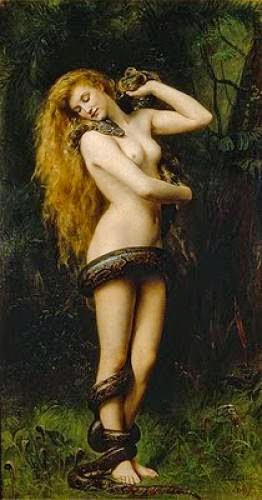
There are lots of Goddesses and Gods starting with "L", but nothing better than Lilith, the independent deity!
This dark Sumerian Goddess is often misinterpreted, but I do like Her. I found an excellent site that summed up pretty well her lore:
"Lilith first appeared in Sumerian mythology about 5,000 years ago. As "handmaid" to the Goddess Inanna, Queen of Heaven, she would gather men in from the fields for the sacred rites. In another Sumerian story, Lilith lives in the sacred huluppu tree that Inanna has planted in her holy garden, accompanied by the snake who cannot be charmed and the wild Anzu-bird and her young. These creatures are part of Lilith's untamed nature and have knowledge to give Inanna, who is not yet ready to accept it. So Inanna calls in her brother, Gilgamesh, to cut down the tree. The serpent is killed, the Anzu-bird and its family fly off to the mountains, and Lilith departs for the wilderness.
This story may be the foundation of the most well-known Hebrew myth of Lilith as the first wife of Adam. According to one version of the story, Yahweh creates both Adam and Lilith from earth, but with one important difference: he uses impure sediments to create Lilith, whereas Adam has been fashioned from pure dust. Because of this, Adam expects Lilith to be submissive to him, but, claiming equality, she will not be put beneath him and flies away to lifelong exile near the Red Sea, where she mates with evil spirits and bears scores of demonic children. Meanwhile, Yahweh again tries to create a partner for Adam, this time taking one of his ribs and turning it into Eve - now she is a creation from Adam and not one in her own right, like Lilith. Myth has it that the jealousy and rage generated by Adam's rejection motivate Lilith to come in the night for her revenge, strangling babies and giving men wet dreams to sap their strength. Amulets were worn to ward her off."
How awesome is that?! Except for the 'strangling babies' part, I love how she dealt with the men who crossed her will (some men deserve this... Maybe not all men, but some do deserve it, lol!).
For more L posts, visit the ABC page, created by Denise Nesbitt, and join the fun!
Tags: audio book socrates plato aristotle mars enters pisce living might mean taking chances but theyre worth taking pagans and warlock christian pop sightings mart walkthrough flesh golem spell elite spell magic spells chants