skip to main |
skip to sidebar
' "
Interestingly, my dream this morning - Shamanic Heartwalk, Unifying Covenants - has correspondences with the Kiphonus Gate of the Temple Mount. The Kiphonus Gate is the only gate (on the western side of the Temple wall) which leads directly (through a 50 foot tunnel) to the Temple Mount (Har HaBayit).
Importantly, my dream links to this 50 foot tunnel beyond the sealed up Kiphonus Gate which leads directly to the Temple Mount.
The rainbow light sensor of my dream corresponds to the boundary of the sealed up Kiphonus Gate which few may pass beyond. The upwardly curving lighted road beyond the rainbow light sensor of my dream corresponds to the 50 foot tunnel beyond the Kiphonus Gate. "The Light of The "Place of Making" Requests" in my dream corresponds to the "Kodesh HaKadoshim" (Holy of Holies).
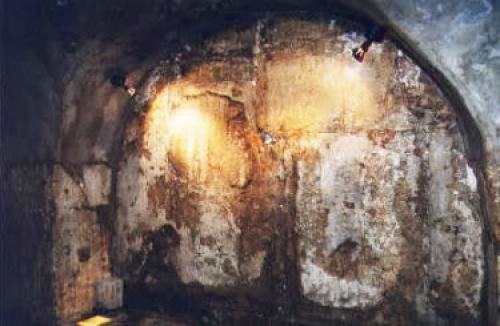
Hat-tip to Mystical Paths for picture under the kotel.
Tags: dark halloween side do voodoo love spells work the good unbelief black magic curse magic spells chants two temple place wc2
Roland arrived at A personal ordinariate from The Church of England by searching for a safe haven from the liberals - 2 seconds ago
Lucian arrived at Opus Dei from Moderate Catholicism by searching for more discipline - 4 seconds ago
Elsie arrived at The Church of England from Catholicism by searching for ordination - 8 minutes ago
Archie arrived at The Beaker Folk of Husborne Crawley by searching for tea lights - 10 minutes ago
James arrived at The United Reformed Church from Evangelicalism by searching for warm fuzzies - 15 minutes ago
Oddric arrived at Methodism from The Stewartby Guinea Pig Worshippers by searching for Blessed Assurance - 20 minutes ago
Martin arrived at ECUSA from Assemblies of God by searching for gay bishops - 20 minutes ago
Ralph arrived at Stewartby from Husborne Crawley by searching for guinea pig gods - 25 minutes ago
Harold arrived at Paganism from The Jehovah's Witnesses by searching for women with tattoos and piercings - about 1 hour ago
Arfwit arrived at Fundamentalism from Sanity by searching for an escape from the modern world - about 2 days ago
Tony arrived at The Vatican from Westminster searching for the european presidency - 2 years ago
Richard arrived at Assertive Atheism searching for a safer world + more book deals - 8 years ago
Ann arrived at Catholicism from The Church of England by searching for priests that aren't women - 17 years ago
John Henry arrived at The Oratory from Oxford - 160 years ago
John W arrived at Methodism from High Anglicanism by searching for a warmed heart - 200 years ago
Henry arrived at The Church of England from Roman Catholicism by searching for a younger woman - is that so wrong? - about 500 years ago
Paul arrived at The Way from Pharisaism by searching for Heretics - about 2000 years ago
Moses arrived at Judaism by searching for the Promised Land - about 3500 years ago
Credit: http://wiccalessons.blogspot.com
By Matthias Zeitler
Chinese astrology associates horses with male and the sheep with its female characteristics as its complementary sign. A horse is attractive, has a strong sex appeal and is a symbol of male virility and sexual prowess. A horse is attracted to the outdoors and you will find him biking, jogging, rock climbing or hiking. He is a veritable human dynamo and comes across as a vivacious free spirit because of high energy levels.
Metal horses are fond of adventure and love to wander about and explore places. They love their freedom and shy away from commitments.they won't be tied down to one partner for life and that's why prefer friendships to serious romantic relationships. They find it easy to attract people through their untamed spirit, zeal and enthusiasm and are reputed to be excellent friends. They have faith in their own judgment and instinct and are determined and ambitious people.
Persuasive, adaptable and intuitive, water horses are skilful orators and unlike their elemental counterparts, are most indecisive. They are always wavering, always try to go with the flow and keep changing their minds. This often confuses friends and colleagues but is misinterpreted as the horse's ability to adapt. It takes a water horse a jiffy to put a smile back on your face and cheer you up.
Wood horses stand for stability and strength, organizational skills and good leadership qualities, self confidence and generosity, righteousness and good work ethics, adaptability and ability to work in tandem with others. They don't expect to be bossed around and are successful in life and love. They are more predictable than their elemental counterparts for they can stick to their decisions.
Earth horses are disciplined, organized, systematic, practical, dependable, down to earth and easygoing, assiduous hard workers who will never compromise on the quality of their work, extremely adaptable and possess a good sense of humor. Before taking a final decision they analyze a situation well from all angles.
Fire horses are spiritually inclined, intelligent, popular, charming, knowledgeable, born winners, adventurous and courageous, always ready to try out new things, attractive and sociable, optimistic and are born leaders. They are congenial and helpful creatures by nature and are considered as destiny's children. The element fire ignites their intense feelings and passions. They are decisive, love exciting challenges and the change that is brought about by new stimulants.
Positive Side of Horse Character
Some of the many admirable qualities that a horse has are intelligence, strength, independence, enthusiasm, charm, creativity, leadership qualities, wit, optimism and frankness. This colorful, dapper figure catches our attention through his active vitality.
Negative Side of Horse Character
But on the flip side he has a quick temper, a rebellious spirit, an inconsistent and impatient nature. He is also gullible, defiant, tactless, a bit of an egoist, self indulgent and selfish.
This desperado would do well to pay heed to the eagles song which says you better let somebody love you before it's too late. Instability, fickleness, rashness and an urge to act on impulse are some of his deplorable drawbacks.
If you are interested in horoscope horse then install Biotrend to learn more about chinese horoscope compatibility
Tags: review shaman pathways web firefly firefly gem guide pocket reference voodo love spells roman catholic church eastern catholic church largest mamal in history of world candle magic books spencer pratt born ag
The most important of the WICCAN SUPPLIES you will have are the foundation pieces of your altar.
Altars generally have items on them that represent the five elements of earth, air, fire, water and spirit, which may take many forms. Here are some of the essential basic WICCAN SUPPLIES for your altar:
*
THE ATHAME - a ritual double edged metal dagger with a wooden handle. As its purpose is to mark sacred space, it is "never" used to cut anything physical. Athames are associated with the element of air and male energy,
*
THE CHALICE - a symbol of the feminine, it is usually a stemmed goblet. The chalice is associated with water, psychic ability and the subconscious.
*
ALTAR BELL - generally a small metal hand bell used to clear sacred space, and punctuate parts of ritual or spellwork. Bells are associated with the element of air.
*
ALTAR TILE - also known as a pentacle or peyton. The altar tile is used to open elemental gateways, evoke the divine and to protect and bless ritual tools and food. The elemental representation can be either earth or spirit.
*
ALTAR CLOTH - protects the altar from stray wax, embers, dirt, and grime. The average altar cloth is traditionally black however when celebrating a Sabbat, Esbat, or doing specific spellwork, a colour that is representational of the event being observed can be used.
*
THE WAND - wands are usually made of wood and are used to project or direct energy to a specific area, object, or person. The elemental correspondence is fire.
*
THE BESOM - A besom is a ritual broom used to clear the residual energy from a space being prepared for ritual, and is one of the only Wiccan supplies that is used for ritual, but may not be found on the altar itself.
*
CAULDRON - Used to burn, brew and mix things, it represents all the various elements, depending on how it is used. When used to burn offerings, it represents fire; used to brew a potion, it represents water; used for incense, air; and a cauldron of abundance, like a cornucopia, is associated with the element of earth. Usually made of iron and standing on three legs, the cauldron represents the feminine.
*
CANDLES - there are usually three candles on the altar: one black, representing the Goddess; one white, representing the God, and a third, usually also white, for lighting. Candles represent the element of fire.
*
A CENSER - this can be any flame-proof vessel used for burning incense. Some censers are cauldron like, and are hung on chains or suspended in tripods. A censer represents the element of air.
Although further items may be added to the altar according to the work being completed or the time of year, these are the essential basic WICCAN SUPPLIES to be found on Pagan and Wiccan alters.
If you would like to find out more about Wiccan supplies and their uses, go to this website here.
Tags: folklore fairytale beginner guide to wicc point of view literature power point t george georgia hoodoo magic spell learning to lucid dream pirit guides angry spirit
One of the traditional pastimes during the Dragon Boat Festival is the egg standing contest (, l`i d`an bs`ai). The aptly titled egg standing contest consists of players attempting to get a raw egg to stand up.
WHY DO PEOPLE PLAY THE EGG STANDING GAME ON DRAGON BOAT FESTIVAL?
The Dragon Boat Festival is held on the fifth day of the fifth lunar month, which is traditionally an unlucky month. To ensure luck for the coming year, people compete in egg standing contests. It is believed that making an egg stand on this day, especially at mid-day, will bring luck.
CAN YOU REALLY MAKE AN EGG STAND UP?
It is possible to make the egg-stand up; though many people try to cheat by tampering with the eggs. Taking a raw egg and placing it straight up is doable though an urban legend claims it is only possible on the summer solstice, the longest day of the year.
However, you can make the egg stand straight up any day you choose by just being patient and carefully setting it on a flat surface. It's easier to place the egg on its wider side and use the natural bumps on the egg to help balance it.
To make egg standing easier to accomplish, you can place the egg on the ground or spread salt on the table, place the egg on top and then blow the salt away.
Found at: Chinese Culture
Tags: black magick spell magic head fly motivational mondaytuesday family pagan week candle magick nearer my god thee roman and greek gods and goddesses
Dala'il Al-Khayrat: The Story of a Text - By Adam Larson
"God and his angels bless the Prophet.O believers bless him and pray him peace as well"- Qur'an 33:56
The eminent scholar and mystic of fifteenth century Egypt, Jalal al-Din al-Suyuti, tells the story of an early mystic:
One night I fulfilled a number of blessings on the Prophet and I fell asleep.
I was dwelling in a room, and lo, the Prophet came to me through the door, and the whole room was lit up. Then he moved towards me and said: "Give me the mouth that has blessed me so often that I may kiss it." And my modesty would not let him kiss my mouth; so I turned away my face, and he kissed my cheek. Then I woke trembling from sleep and my wife who was by my side awoke, and lo, the house was fragrant with his scent, and the scent of musk from his kiss remained on my cheek about eight days. My wife noticed the scent every day.
This story beautifully illustrates the centrality of the Prophet Muhammad (God bless him and give him peace) to Islamic piety. For hundreds of years Muslims have meditated on and lucidly expressed their deep love for the Chosen Prophet (God bless him and give him peace); they have collected and compiled every available account concerning him, produced immense commentaries detailing his every feature, from the length of his hair and the color of his complexion, to the way he walked, slept, and laughed, and have composed lyrical poetry giving voice to their immense longing for him.
The Prophet (God bless him and give him peace) said, "The person nearest to me is the one who asks for blessings upon me the most." Throughout history Muslims have sought continual presence with the Prophet (God bless him and give him peace), manifesting their love for him by adhering to God's command: "bless him and pray for peace upon him" (The Qur'an, Sura al-Ahzab). In the spirit of this command, Muslim scholars have produced prayer manuals of the utmost beauty and eloquence. These manuals most frequently consist of collections of prayers, supplications, and praise from the Qur'an and hadith, as well as original compositions. Of these prayer manuals, perhaps none have been more successful and widespread than Muhammad b. Sulayman al-Jazuli's masterwork Dala'il al- Khayrat wa Shawariq al-Anwar fi Dhikr al-Salat 'ala al- Nabi al-Mukhtar (The Guide to Blessings and the Advent of Light in Blessing the Chosen Prophet). Composed in Morocco in the fifteenth century, Dala'il al-Khayrat quickly spread throughout the Muslim world, from Turkey, to East Africa, to Sumatra.
WHO WAS AL-JAZULI? Why was Dala'il al-Khayrat so popular? How have Muslims interacted with and experienced the text, both as a performative act and as a physical object? By exploring these questions, it is hoped that the reader may gain a fuller understanding and greater appreciation of this extraordinary text, its author, and its inspiration.
THE CONTEXT AND FORMATION OF DALA'IL AL-KHAYRAT: THE LIFE OF MUHAMMAD B. SULAYMAN AL-JAZULI
At the dawn of the fifteenth century, the Marinid dynasty had ruled Morocco for over one hundred and fifty years. The early Marinid period was marked by military campaigns and vigorous architectural activity. They built a variety of structures: new urban centers, zawiyas, fortresses, and mosques. However, their most marvelous architectural contributions were madrasas: four at Fez and one at Sal'e. In the oldest of these madrasas, Madrasat al-Saffarin in Fez, young Muhammad b. Sulayman al-Jazuli received instruction in the religious sciences.
By the mid-fifteenth century, Moroccan society was in chaos. Corruption and immorality were rampant in both the cities and the countryside. Port cities along the Atlantic and Mediterranean coasts fell to the crusading Portuguese. Due to internal strife and foreign military pressure, the Marinid state began to fragment. Morocco was in need of religious reform and reorientation. It was precisely at this trying time that al-Jazuli introduced his remarkable work Dala'il al- Khayrat.
Abu 'Abdullah Muhammad b. 'Abd al-Rahman b. Abi Bakr b. Sulayman al-Jazuli al-Samlali was born to a sharif [a descendent of the Prophet Muhammad] family in the southern Moroccan village of Tankarat in the early fifteenth century. He belonged to the Simlala, an important subtribe of the Sanhaja Berbers that lived on the Sus River plain between the High Atlas and Anti-Atlas Mountains. Little detail is known about his life. However, his biographer, Muhammad al-Mahdi al-Fasi (d.), mentions in his work Mumti' al-Asma' a number of anecdotes and pithy expressions, giving a glimpse into the religious world of early modern Morocco.
As a young scholar al-Jazuli left his homeland of Jazula because inter-tribal conflicts made serious study impossible. He traveled to Fez and enrolled at Madrasat al-Saffarin, where his room is still shown to visitors. In Fez he memorized works of usul al-fiqh and Maliki law, such as Ibn al-Hajib's Mukhtasr al-Far'i and Sahnun's Al-Mudawwana al-Kubra. He also met the famous jurist and mystic Sheikh Ahmad Zarruq. As a youth he became known for his piety. Al-Fasi relates a stunning example of al-Jazuli's detachment from worldly concerns:
While he was attending the madrasa, he secluded himself in a house and no one else would enter. This news reached his father who thought the youth's persistence in barring others from entering was because he was hiding wealth, so he set out to visit his son. He requested permission to enter his son's house and was given leave. When he entered he saw written all over the walls: "Death, Death, Death..." He understood what his son was up to. He reproached himself, saying, "Look where he is and look where we are!" Then he left his son and returned home.
Several accounts detail al-Jazuli's inspiration in writing Dala'il al-Khayrat. According to al-Fasi, he collected Dala'il al-Khayrat from The reason for al-Jazuli's writing Dala'il al-Khayrat... was that one day he was late for his prayers, even though it was his custom to seek the approval of God the Exalted by not delaying a prayer beyond the earliest possible time for its performance. When he arose to make his ablutions, however, he was unable to find anything with which to take water out of the well. This preoccupied him greatly and he was very annoyed. While he was in this state a young girl caught sight of him from a high place and said, "Who are you, uncle?" The sheikh then told her about himself, hoping that she would give him a bucket and thus ease his cares and worries. Instead the girl exclaimed, "You are the one whom people praise greatly, yet you are unable to take water from a well in order to purify yourself !"
Then she came down from that high place and spat into the well while reciting the Name of the Lord of Creation. No sooner had she done so than water tasting as sweet as the sweetest sugar poured forth from the well until it spilled over the face of the earth as a miracle from the One who rolls up the scroll of time. The sheikh made his ablution and marveled at this splendid miracle. When he finished, he swore by God Almighty that the girl should reveal to him how she had acquired this great rank. "By making constant prayers on the Best of Creation (may God bless and preserve him) to the number of breaths and heartbeats (bi-'adad al-anfas wa al-daqa'iq)," she replied.
So al-Jazuli resolved at that moment to write a book about the excellence of prayers on behalf of the Chosen Prophet and to include in it many transmitted texts from the mine of prophecy and from those who have drowned in the sea of the effusion of God's abundant generosity. All of this (which was due to what he perceived in this great miracle) would not have been possible had it not been for this girl, who was devoted to reciting prayers on the Adornment of the Last Day (zayn al-qiyama).
Al-Jazuli took the Shadhili tariqa from Abu 'Abdullah Muhammad Amghar al-Saghir (d.) of Ribat Tit-n- Fitr. After taking part in the resistance to the Portuguese at Tangier in, he went into seclusion (khalwa). Some historians claim that he worshiped in isolation for fourteen years; while others maintain that he traveled east for sometime, reciting Dala'il al-Khayrat twice each morning to the Prophet (God bless him and give him peace) in Medina.Upon his reemergence in, al-Jazuli established a zawiya at the Atlantic port city of Asafi.
Al-Jazuli was "frequent in reciting litanies (awrad), observant of God most High in all his states, not exceeding the boundaries God established, and exerting himself in following the Book of God and the example of his Messenger (God bless him and give him peace)." He founded the Shadhiliyya Jazuliyya order, with Dala'il al-Khayrat at its core, and over,disciples received spiritual training (tarbiya) at his hands.
Later writers describe the nature of al-Jazuli's relationship with the Prophet (God bless him and give him peace): there mixed, in his person, "the two loves"-the love one feels for the Prophet due to religion, and the love one feels for one's kinsfolk (mahabba al-diniyya wa al-tiniyya).Al-Jazuli died in while prostrating during the morning prayer, the victim of poisoning. He was later buried at Riyadh al-'Arus in Marrakesh. Known in the local dialect as "Sidi Ben Sliman," he is one of the seven patron saints of Marrakesh. He left Dala'il al-Khayrat as a testament to his immense love and longing for the Prophet (God bless him and give him peace):
O God, I believed in Muhammad but did not see him; do not deprive me in the Gardens of his vision. Bestow his company upon me and cause me to die in his religion. Let me drink from his pool a quenching, pleasant, delightful drink after which we shall never thirst again. You are powerful over everything. O God, convey to the soul of Muhammad my greetings and peace. O God, as I believed in Muhammad but did not see him, do not deprive me in the Gardens of his vision.
Tags: candles magic the hathors decreasing energetic alice hoffman book lords evening meal 2009 30 box enhance life love love potent spell spell mesopotamian mythology
St. Nicholas the Wonderworker (Feast Day - December 6)
By Protopresbyter Fr. George Papavarnavas
The truth of things revealed thee to thy flock as a rule of faith, an image of meekness and teacher of temperance; wherefore, thou hast attained the heights through humility and riches through poverty, O hierarch Nicholas our father, entreat Christ God, that our souls be saved.
The state of the imitator of Christ and popular wonderworker Saint Nicholas, the patron of those at sea as well as all those who seek his God-persuading intercessions, exudes the fragrance of faith. A lively and genuine faith, which is expressed as a way of life. Rightly has he been called a "rule of faith", since he held the faith of vision, that is, he had the personal experience of the existence of God. He saw the uncreated Light and acquired knowledge of living beings. "For You are the Source of Life, and by Your Light shall we see Light." At the First Ecumenical Synod (325 AD), in which he participated, he gave his own testimony and confession of faith and imprinted his own stamp on it. With the boldness that distinguished him he put to shame the insolent mouth of the heresiarch Arius. When he blasphemed Christ, the Saint, who is called an "image of meekness", stood up and slapped him. For meekness, which is a fruit of the Holy Spirit, is not an impassioned state, but a dynamic state of life. A meek person is not one who is not angered, but one who angers without sinning, as the Scripture says: "Be angry, and sin not." When anger has its root and cause in the passions, then surely it will lead to sin and the loss of divine Grace. The saints, however, as dispassionate, do not become angry out of personal touchiness or to salvage their individual dignity. They are enraged without losing control of themselves when God is blasphemed and dishonored and the Faith is in danger of being altered, on which the salvation of humanity depends. This anger is not passionate and its motive is an unselfish love for God and man. Those who dishonor the name of God and mock divine things bear a heavy illness and urgently require a "scalpel", that is, strictness until the illness is healed. The case of the High Priest Eli is known from the Old Testament, who was punished by God for not being as strict with his children as he should have been, for they repeatedly disdained God and His Law and were scandalizing the faithful.
The Saint was also among other things a "teacher of temperance". Temperance as a way of life encompassed his entire behavior: he was temperate in joy and in sorrow, temperate in food, laughter, vision, hearing, everything. In all things, he was a balanced man.
For his great philanthropy he received the gift of wonderworking. With this gift he helped very many people. He runs to help all those who call upon him with faith and he carries out their request, of course if it is for the persons interest, which is salvation. In his synaxarion, as well as in a hymn on his feast, it is mentioned that he saved three people, who were victims of slander, from certain death. Indeed, this incident shows the great boldness he has before God. He appeared in a dream to Emperor Constantine, revealed the innocence of these people, and ordered him to release them. He also strictly stressed that, if he disobeyed, he would denounce him before God, the true and eternal King, and he would have to deal with Him. As the sacred hymnographer very beautifully says: "But if you will disobey me, I will petition the Lord and King against you when I pray!"
However, the gift of working miracles is not the only, nor the greatest, gift in the Church. We have written in other places about the other gifts, such as the gift of Theology, the gift of Love, etc. The gift of wonderworking is usually given to those saints who have great love for people. For the people of God a miracle is not surprising or an unlikely thing, but it is something very natural, since God is Almighty and for Him all things are possible. During the course of a miracle physical laws are not removed, since there are no physical laws, but God simply wants to do some act at that moment, and He does it in His own way. In creation there are uncreated spiritual logoi, in other words, there are things like love and the providence of God which govern the world. For God did not create the world just to abandon it, but He personally giverns it Himself with His uncreated grace of foreknowledge.
Finally I would be remiss not to mention, even in writing, two other gifts of his, that are referred to in his Apolytkion: humility and poverty.
All the effort and struggle of the faithful in the Church are to learn the meekness and humility of Christ. "Learn from Me, for I am meek and humble of heart, and you will find rest for your souls." The Saint acquired great and high things with lofty humility. He experienced, however, like all the Saints, deliberate material poverty. But he was truly rich because he had a rich heart and held a spiritual treasure. He was poor, like all the Apostles, but he made many rich, because he was, like them "having nothing, he had everything".
Father Hierarch Nicholas, you who are, and as your name reveals, the conqueror of the people, as well as their protector and consolation, "entreat Christ our God, that our souls may be saved".
Source:: http://i-love-witchcraft.blogspot.com