skip to main |
skip to sidebar
By Metropolitan Methodios of Boston
"Sadly, Sunday has lost its significance in our society, becoming less of a day of worship of almighty God and more like any ordinary work day. This especially affects our young people who are obligated to attend sports events on Sunday mornings rather than attend the Divine Liturgy. At my request, this sad reality and its ramifications were discussed at the recent meeting of the Orthodox-Roman Catholic Consultation. After lengthy discussion, the following joint statement was issued. I ask you to read it carefully and approach civic, business and school authorities in your community to schedule sports events after 12 noon so that our young people may worship together with their families on Sunday mornings. "
THE IMPORTANCE OF SUNDAY
The North American Orthodox-Catholic Theological Consultation
Saint Paul's College, Washington, DCOctober 27, 2012
Recovering the theological significance of Sunday is fundamental to rebalancing our lives. As Orthodox and Catholics, we share a theological view of Sunday and so our purpose in this statement is four-fold: to offer a caring response to what is not just a human, but also a theological question; to add a little more volume to the growing chorus of Christian voices trying to be heard in the din of our non-stop worklife; to offer brief reflections in hopes of drawing attention to the fuller expositions elsewhere; and to reinforce the ecumenical consensus by speaking as Orthodox and Catholics with one voice.
For Christians, Sunday, the Lord's Day, is a special day consecrated to the service and worship of God. It is a unique Christian festival. It is "the day the Lord has made" (Ps. 117 (118):24). Its nature is holy and joyful. Sunday is the day on which we believe God acted decisively to liberate the world from the tyranny of sin, death, and corruption through the Holy Resurrection of Jesus.
The primacy of Sunday is affirmed by the liturgical practice of the early church. St. Justin the Martyr writing around 150 AD notes that "it is on Sunday that we assemble because Sunday is the first day, the day on which God transformed darkness and matter and created the world and the day that Jesus Christ rose from the dead ("First Apology", 67)." Sunday has always had a privileged position in the life of the church as a day of worship and celebration. On Sunday the Church assembles to realize her eschatological fullness in the Eucharist by which the Kingdom and the endless Day of the Lord are revealed in time. It is the perpetual first day of the new creation, a day of rejoicing. It is a day for community, feasting and family gatherings.
As we look at our fellow Christians and our society, we observe that everyone is short of time and stressed. One reason is that many of us have forgotten the meaning of Sunday, and with it the practices that regularly renewed our relationships and lives. More and more Christian leaders see the effects of a 24/7 worklife and ask "Where is the time of rest?" As members of the North American Orthodox-Catholic Theological Consultation, gathered October 25-27, 2012, we add our combined voice to their call.
Our purpose here is not to replace or replicate their message; it is to underscore and point to it. Anyone who looks at the 1998 Apostolic Letter "Dies Domini "("The Lord's Day") of Pope John Paul II and its cascade of patristic quotations will see there is already a feast of food for thought on the meaning of Sunday. Anyone who reads the recent book "Sunday, Sabbath, and the Weekend" (2010, Edward O'Flaherty, ed.) will see there is also strong ecumenical consensus on the need to recover the meaning of Sunday- not just for our souls, but for our bodies, our hearts, and our minds as well.
Sadly Sunday has become less of a day of worship and family and more like an ordinary work day. Shopping, sports, and work squeeze out the chance for a day of worship or rest in the Christian sense. By abandoning Sunday worship we lose out on the regenerative powers that flow out of the liturgical assembly. And when Sunday becomes detached from its theological significance, it becomes just part of a weekend and people can lose the chance to see transcendent meaning for themselves and their lives ("The Lord's Day", 4).
Sunday is more than just the first day of the week. In our faith we see how it is the ultimate day of new beginnings: "It is Easter which returns week by week, celebrating Christ's victory over sin and death, the fulfillment in him of the first creation and the dawn of "the new creation" (cf. 2 Cor 5:17). It is the day which recalls in grateful adoration the world's first day and looks forward in active hope to "the last day", when Christ will come in glory (cf. Acts 1:11; 1 Th 4:13-17) and all things will be made new (cf. Rev 21:5. "The Lord's Day", 1)."
Sunday even unlocks the mystery of time itself, for "...in commemorating the day of Christ's Resurrection not just once a year but every Sunday, the Church seeks to indicate to every generation the true fulcrum of history, to which the mystery of the world's origin and its final destiny leads ("The Lord's Day", 2)." The Lord's Day is the day after the last day of the week and so it symbolizes eternity as well: what St. Augustine calls "a peace with no evening (Confessions 13:50)." St. Basil the Great in his Treatise on the Holy Spirit writes, "Sunday seems to be an image of the age to come... This day foreshadows the state which is to follow the present age: a day without sunset, nightfall or successor, an age which does not grow old or come to an end ("On the Holy Spirit" 26:77)."
The apostolic letter of Pope John Paul II calls it a day of joy, rest, and solidarity. Joy there is, because the disciples are always glad to see the Master. God scripturally established a day of rest as a gift to us, and rest there must be for every human person. Rest is built into our nature and also withdraws us "...from the sometimes excessively demanding cycle of earthly tasks in order to renew [our] awareness that everything is the work of God. There is a risk that the prodigious power over creation which God gives to man can lead him to forget that God is the Creator upon whom everything depends. It is all the more urgent to recognize this dependence in our own time, when science and technology have so incredibly increased the power which man exercises through his work. Finally, it should not be forgotten that even in our own day work is very oppressive for many people, either because of miserable working conditions and long hours - especially in the poorer regions of the world - or because of the persistence in economically more developed societies of too many cases of injustice and exploitation of man by man ("The Lord's Day", 65,66)."
As members of the Consultation, we strongly urge both clergy and laity to work cooperatively within their communities to stress the importance of Sunday for worship and family. Foremost we call for all to render thanks to God and render love towards one another - and be willing to reserve time to do both - and avail ourselves of the riches of the Lord's Day. Appropriate authorities can be approached to schedule sports activities after 12 noon in order to give young athletes and their family the opportunity to worship on Sunday morning. We call for our children to live in a timescape that respects the God-given rhythm of the week.
"Yes, let us open our time to Christ, that he may cast light upon it and give it direction. He is the One who knows the secret of time and the secret of eternity, and he gives us "his day" as an ever new gift of his love. The rediscovery of this day is a grace which we must implore, not only so that we may live the demands of faith to the full, but also so that we may respond concretely to the deepest human yearnings. Time given to Christ is never time lost, but is rather time gained, so that our relationships and indeed our whole life may become more profoundly human ("The Lord's Day", 7)."
Source
Tags: incredible skeletal remains christian churches together urges aleister crowley spells an astral projection mall ancient sea shell attract abundance black magic book
By Tracy Rocelyn
1971 - Yusuke Naora, Japanese game art director 1972 - Eddie Mason, NFL linebacker (NY Jets) 1972 - Jay Powell, Meridian MS, pitcher (Florida Marlins) 1972 - Kristie Hicks, Bardstown Kentucky, Miss America-Kentucky (1996) 1972 - Sarah Beeny, British TV personality 1972 - Angie Martinez, American radio and television personality 1972 - Jay Powell, baseball player 1973 - Aaron Holbert, US baseball infielder (St Louis Cardinals) 1973 - Ronald Hamming, soccer player (FC Groningen, Fortuna Sittard) 1974 - Craig Wishart, cricketer (Zimbabwe Test batsman vs South Africa 1995) 1974 - Jamain Stephens, NFL offensive tackle (Pittsburgh Steelers) 1974 - Farhan Akhtar, Indian Bollywood Director, Actor, Producer, Singer. 1975 - Justin Huish, Fountain Valley CA, archer (Olympics-gold-1996) 1975 - Mariano Friedick, Tarzana Calif, pursuit cyclist (Olympics-96) 1975 - Kiko Calero, Puerto Rican baseball player
1975 - Kimberley Ann Scott Mathers, former wife of Eminem 1976 - Amy Safe, Australian rower (Olympics-96) 1976 - Radek Bonk, Koprivnice Cze, NHL center (Ottawa Senators, Team Czech) 1976 - Todd Grisham, American professional wrestling interviewer 1977 - Beth Troutman, American production assistant 1978 - Gennaro Gattuso, Italian footballer 1978 - Mathieu Garon, Canadian ice hockey player 1978 - Chad Johnson, American football player 1978 - AJ McLean, American singer (Backstreet Boys) 1978 - Maggie Rizer, American model and AIDS activist 1979 - Lavinia Magruder, Miss Vermont Teen USA (1996) 1979 - Tomiko Van, Japanese singer 1980 - Sergio Garca, Spanish golfer 1981 - Euzebiusz Smolarek, Polish footballer 1987 - Lucas Pezzini Leiva, Brazilian and Liverpool Footballer 1987 - Sam Bird, English racing driver 1987 - Paolo Nutini, Scottish singer/songwriter 1987 - Pablo Santos, Mexican actor (d. 2006) 1989 - Michaella Krajicek, Dutch tennis player 1997 - Lauryn McClain, American actress and singer
1897 - Karl Lwith, German philosopher (d. 1973) 1898 - Gracie Fields, [Stansfield], England, music hall/vaudeville performer 1898 - Vilma Banky, Budapest Hungary, silent screen actress (Eagle, Rebel) 1898 - Wally Baker, American supercentenarian 1900 - Joseph Frederick Wagner, composer 1900 - Richard Halliburton, American adventurer (presumed dead 1939) 1901 - Chic Young, cartoonist (Blondie) 1902 - Rudolph Bing, opera manager (NY Metropolitan Opera) 1903 - Hem Vejakorn, Thai illustrator (d. 1969) 1904 - George Balanchine, dancer/choreographer/ballet producer [NS=Jan 22] 1908 - Simone de Beauvoir, France, author (Mandarins, 2nd Sex) 1909 - Herva Nelli, soprano 1910 - Dick Henry Jurgen, bandleader 1911 - Richard Selwyn Francis Schiling, professor of occupational health 1911 - Stafford WIlliam Somerfield, British newspaper editor 1912 - Ralph Tubbs, architect 1913 - Lavad "Dr Hepcat" Durst, vocal/piano 1913 - Peter John Norton, naval diplomat/artist 1913 - Richard Milhous Nixon, (R) 37th pres (1968-74) (I am not a crook!) 1914 - Derek Allhusen, England, equestrian (Olympic-gold-1968) 1914 - Gypsy Rose Lee, [Rose Hovick], Seattle, burlesque actress (Gypsy) 1914 - Kenny [Klook] Clarke, Pittsburgh, jazz/drummer, composer (Epistrop) 1915 - Anita Louise, NYC, actress (My Friend Flicka) 1915 - Fernando Lamas, Buenos Aires Argentina, actor ("You look marvelous") 1916 - Alain Bernardin, impressario (Crazy Horse Saloon) 1916 - Vic Mizzy, Bkln NY, orch leader (Don Rickles Show) 1916 - Peter Twinn, English World War II code-breaker (d. 2004)
1822 - The Portuguese prince Pedro I of Brazil decides to stay in Brazil against the orders of the Portuguese king Joo VI, starting the Brazilian independence process. 1839 - The French Academy of Sciences announces the Daguerreotype photography process. 1857 - The Fort Tejon earthquake of California occurs, registering an estimated magnitude of 7.9. 1858 - Anson Jones, the last President of the Republic of Texas, commits suicide. 1861 - American Civil War: The "Star of the West" incident occurs near Charleston, South Carolina. It is considered by some historians to be the "First Shots of the American Civil War". 1861 - Mississippi becomes the second state to secede from the Union before the outbreak of the American Civil War. 1863 - American Civil War: the Battle of Fort Hindman begins in Arkansas. 1878 - Umberto I becomes King of Italy.
1880 - The Great Gale of 1880 devastates parts of Oregon and Washington with high wind and heavy snow. 1894 - New England Telephone and Telegraph installs the first battery-operated telephone switchboard in Lexington, Massachusetts. 1903 - Hallam Tennyson, 2nd Baron Tennyson, son of the famous poet Alfred Tennyson, becomes the second Governor-General of Australia. 1905 - According to the Julian Calendar which is used at the time, Russian workers stage a march on the Winter Palace that ends in the massacre by Tsarist troops known as Bloody Sunday, setting off the Russian Revolution of 1905. 1909 - Ernest Shackleton, leading the Nimrod Expedition to the South Pole, plants the British flag 97 nautical miles (180 km; 112 mi) from the South Pole, the furthest anyone had ever reached at that time. 1914 - Phi Beta Sigma Fraternity Inc., the first historically black intercollegiate Greek-letter fraternity to be officially recognized at Howard University is founded. 1916 - World War I: The Battle of Gallipoli concludes with an Ottoman Empire victory when the last Allied forces are evacuated from the peninsula. 1917 - World War I: the Battle of Rafa occurs near the Egyptian border with Palestine. 1918 - Battle of Bear Valley: The last battle of the American Indian Wars. 1921 - Greco-Turkish War: The First Battle of nn, the first battle of the war, began near Eskiehir in Anatolia. 1923 - Juan de la Cierva makes the first autogyro flight.
1923 - Lithuanian residents of the Memel Territory rebelled against the League of Nations decision to leave the area as a mandated region under French control. 1927 - A fire at the Laurier Palace movie theatre in Montreal, Quebec, kills 78 children. 1941 - World War II: First flight of the Avro Lancaster. 1941 - World War II: The Greek Triton (Y-5) sinks the Italian submarine Neghelli in Otranto. 1945 - World War II: The United States invades Luzon in the Philippines. 1947 - Elizabeth "Betty" Short, the Black Dahlia, is last seen alive. 1960 - President of Egypt Gamal Abdel Nasser opens construction on the Aswan Dam by detonating ten tons of dynamite to demolish twenty tons of granite on the east bank of the Nile. 1964 - Martyrs' Day: Several Panamanian youths try to raise the Panamanian flag on the U.S.-controlled Panama Canal Zone, leading to fighting between U.S. military and Panamanian civilians. 1991 - Representatives from the United States and Iraq meet at the Geneva Peace Conference to try and find a peaceful resolution to the Iraqi invasion of Kuwait. 1992 - The Assembly of the Serb People in Bosnia and Herzegovina proclaims the creation of Republika Srpska, a new state within Yugoslavia. 1996 - First Chechen War: Chechen separatists launch a raid against the helicopter airfield and later a civilian hospital in the city of Kizlyar in the neighbouring Republic of Dagestan, which turns into a massive hostage crisis involving thousands of civilians. 2005 - Elections are held to replace Yasser Arafat as head of the Palestine Liberation Organization. He is succeeded by Rawhi Fattouh.
About the Author:
Famous Birthdays On January 9 - Check Out january 9 astrology and january 9 horoscope
Tags: lender lifestyles slender strips blog tarot focus what do top staying up late magic and spells consolidate debt debt debt debt debt freedom.biz loan settlement the practice of the early church
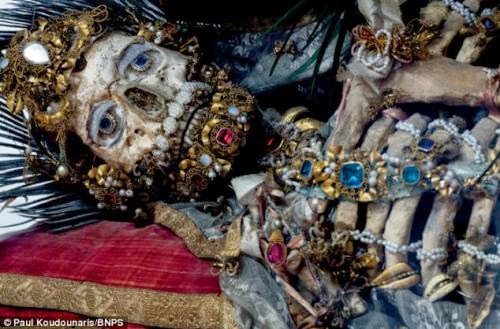
A relic hunter dubbed 'Indiana Bones' has lifted the lid on a macabre collection of 400-year-old jewel-encrusted skeletons unearthed in churches across Europe.
Art historian Paul Koudounaris hunted down and photographed dozens of gruesome skeletons in some of the world's most secretive religious establishments.
Incredibly, some of the skeletons, said to be the remains of early Christian martyrs, were even found hidden away in lock-ups and containers.
ST VALERIUS IN WEYARN: ART HISTORIAN PAUL KOUDOUNARIS HUNTED DOWN AND PHOTOGRAPHED DOZENS OF GRUESOME SKELETONS IN SOME OF THE WORLD'S MOST SECRETIVE RELIGIOUS ESTABLISHMENTS
They are now the subject of a new book, which sheds light on the forgotten ornamented relics for the first time.
Thousands of skeletons were dug up from Roman catacombs in the 16th century and installed in towns around Germany, Austria and Switzerland on the orders of the Vatican.
They were sent to Catholic churches and religious houses to replace the relics destroyed in the wake of the Protestant Reformation in the 1500s.
Mistaken for the remains of early Christian martyrs, the morbid relics, known as the Catacomb Saints, became shrines reminding of the spiritual treasures of the afterlife.
They were also symbols of the Catholic Church's newly found strength in previously Protestant areas.
Each one was painstakingly decorated in thousands of pounds worth of gold, silver and gems by devoted followers before being displayed in church niches.
Some took up to five years to decorate.They were renamed as saints, although none of them qualified for the title under the strict rules of the Catholic church which require saints to have been canonised.
But by the 19th century they had become morbid reminders of an embarrassing past and many were stripped of their honours and discarded.
Mr Koudounaris' new book, Heavenly Bodies: Cult Treasures and Spectacular Saints from the Catacombs, is the first time the skeletons have appeared in print.
Mr Koudounaris, from Los Angeles, said: 'I was working on another book looking into charnel houses when I came across the existence of these skeletons.
'As I discovered more about them I had this feeling that it was my duty to tell their fascinating story.
'After they were found in the Roman catacombs the Vatican authorities would sign certificates identifying them as martyrs then they put the bones in boxes and sent them northwards.
'The skeletons would then be dressed and decorated in jewels, gold and silver, mostly by nuns.
'They had to be handled by those who had taken a sacred vow to the church - these were believed to be martyrs and they couldn't have just anyone handling them.
'They were symbols of the faith triamphant and were made saints in the municipalities.
'One of the reasons they were so important was not for their spiritual merit, which was pretty dubious, but for their social importance.
'They were thought to be miraculous and really solidified people's bond with a town. This reaffirmed the prestige of the town itself.'
He added: 'It's impossible to put a modern-day value on the skeletons.'
SOURCE
Tags: wife's spiritual responsibility abraham blessed isaac magic wands black magic black magic love origins of the ouija board thriving through crisi a review
Read Part 1: The Suffering of Job and Divine Justice
People reading the book of Job today will encounter a strange and disturbing view of God, a view that reflects a theology which affirms that God was the source of both good and evil. This theology is behind the words of Job's four friends who came to sympathize with Job in his time of distress. The dialogue of the four friends with Job was aimed at comforting him, but in the end they concluded that Job was suffering because he had sinned against God.
The friends' inability to understand the real cause of Job's suffering prompted them to accuse Job of being like the wicked: he was reaping the consequences of his wickedness. Their words of accusation were based on their experience and knowledge of God. However, they accused Job because they were unaware of what was transpiring in the council of God. In their attempt at defending God, Job's friends overstated their case by putting the blame on Job.
In their dialogue, Job's friends presented a lofty and unyielding view of God, a view that makes God appear to be removed from the arena of human experience. According to Job's friends' theology, God was so removed from humans that unless a mediator served as a go between God and humans, that separation would leave human beings hopeless when confronted with unyielding justice.
The theology of Job's friends was not all wrong, but neither was their theology right enough to explain Job's suffering. Notwithstanding their words of wisdom, Job's suffering continued. Thus, in the end, human wisdom could not bring the healing or the answers Job was so desperately seeking.
At the end of the dialogue between Job and his friends, God revealed himself to Job. Awed by the divine presence, Job forgot all the bitterness and complaints of his soul. The presence of God required Job's attention. Finally, Job's request to present his case directly to God was granted. As Job had already expressed, he knew that he could not contend with the awesome majesty of Almighty God.
Speaking to Job out of a whirlwind (Job 38:1), the Lord answered none of Job's questions, neither did God explain the reasons he had to endure such torment. No mention was made in God's response to Job of the events in the heavenly court as narrated in the prologue of the story. God had a more powerful way to demonstrate his justice.
The Almighty God revealed himself to Job. How simple that encounter seemed to be, and yet, how profound were the implications of that revelation. In a moment, Job's attitude changed. His life was flooded with purpose, with hope, and with the expectation of healing. God healed Job by bringing him out of his anxiety into acceptance of his situation, an acceptance that brought peace to Job's life.
God's purpose was not only to heal Job, but also to instruct him. God asked Job several rhetorical questions which were beyond human capability of answering.
God wanted Job to catch a glimpse of his work in creation so that Job could realize that his suffering was insignificant when placed next to God's work in the world. At the end of God's questioning, Job recognized the vast gulf between God's wisdom and power and his own ignorance of the many mysteries of life. The greatest lesson Job learned was that God was sovereign over his creation and that divine sovereignty governs all reality, including Job's own life.
At the end of God's encounter with Job, Job humbly repented of his presumption, that he could contend with God. He also repented of his pride in seeing only himself while failing to recognize that God's purpose for his life was much more than he could understand. He bowed in recognition of his insignificance before his sovereign Lord.
Job confessed his unwavering faith in God's sovereignty and his total submission to that sovereignty. Job admitted that he was unable to understand the marvelous work of God, and asked God to grant him wisdom and understanding. Job's repentance signals the end of his intense suffering and the restoration of God's blessings on his life.
The issue that vexes people with such an intensity, the problem of evil, is presented in the book of Job in the form of the suffering of a good and righteous man. His friends tried to console him, but they failed. Their words were not totally wrong. To the contrary, what they said made sense, but not in the case of Job. So, at the end, God himself told them they were wrong in their accusation of Job.
However, at the end of the book, the reader is still perplexed. Why did a good God allow Job's suffering to happen? This question presupposes one very important assumption: whoever asks this question believes in a God of justice. Atheists cannot ask this question. Since they do not believe there is a God, they cannot say God allows this kind of evil to happen.
The problem of the suffering of the innocent is a problem for believers, because they believe in a caring and loving God, a God who is in control of his creation. Those who do not believe in the providence of God, find reasons for human misery by denying or diminishing the God of the Bible.
Many people explain the problem of human suffering by denying the existence of God, by limiting the power and the sovereignty of God, or by affirming that God is not good. Many people are like Job's friends. When people are confronted with the limitations of humanity to understand or explain natural disasters, such as Katrina, Haiti, and Chile, disasters that take hundreds and thousands of human lives, they blame God for these disasters.
When people are challenged by the helplessness of one individual such as Job, a man who suffered and agonized for days and months with an incurable disease, they lose their faith in God and blame the deity for allowing violence, disease, and disasters to occur in the world.
But it is precisely because we know that the Lord is good that we insist that this goodness be shown in the world. It is because we know that the Lord is a righteous judge that we demand that justice be adjudicated in the world. But when we look at the world in which we live, we recognize that goodness and evil are not rewarded evenly. The wicked prosper and the righteous suffer. This was the problem Jeremiah had with God: Jeremiah said: "LORD, you have always been fair whenever I have complained to you. However, I would like to speak with you about the disposition of justice. Why are wicked people successful? Why do all dishonest people have such easy lives?" (Jeremiah 12:1 NET).
In light of such a disparity, how can we continue to believe that God is good? The presence of evil and suffering in the world is evidence to many people that either God is not good or that God is impotent to deal with the problems of the world. But the Bible provides ways of reconciling the problem of suffering with the goodness of God.
The Bible affirms that the God of the Bible is a God of justice: "For the LORD is a God of justice; blessed are all those who wait for him" (Isaiah 30:18). Isaiah says that God's justice will be revealed, but that the believer must wait for it. However, human beings do not have the patience to wait for divine justice to be manifested, either in the near future or at the end of time. People desire to see divine justice manifested while they are alive. Few are willing to wait for divine justice to be done in the life to come. People want justice done in the land of the living.
Human questioning and reasoning about divine justice are important for humans. Job questioned divine justice until he was confronted with the presence of the sovereign and omnipotent God. Job understood the reason for his sufferings no better after his restoration than he understood it when he sat upon the heap of ashes.
Job found wisdom and understanding when he encountered God. The book of Job demonstrates that wisdom is not found in seeking answers to life problems, but in experiencing God. God's justice lies not in what a person perceives as fair, but in God's willingness to justify that person. Perhaps God's justification of Job was the deepest significance and meaning Job found for his suffering. God provides for each person a Justifier and an Advocate, the one whom Job earnestly desired.
To Job, his witness was in heaven: "my advocate is on high" (Job 16:19). Job's words indicate that he saw God as his vindicator. But it is clear that Job saw no vindication in this life. Job believed he was going to die but he knew that he would be vindicated: "As for me, I know that my Redeemer lives, and that at the last he will stand upon the earth. And after my skin has been destroyed, yet in my flesh I will see God" (Job 19:25-26).
To Christians, Jesus Christ is the answer to all Job's questions and to ours. Jesus is the culmination of all that Job wanted God to do for him: "For there is one God, and there is one mediator between God and men, the man Christ Jesus" (1 Timothy 2:5). Only through Jesus can human beings be justified, and only in justification will human beings learn the true meaning of divine sovereignty and divine justice.
NOTICE: My blog has moved to a new address. If you enjoyed reading this post, you can
Source: http://wicca-teachings.blogspot.com
Nomi Morris (Special to the Los Angeles Times)
Erdene Zuu, Mongolia's oldest Buddhist monastery, was built in 1585 in the ancient capital of Kaakorum, once home to 67 temples and 1,500 monks.
"The practice of Buddhism, suppressed for decades by the Communist Party, is being reclaimed by Mongolians as an integral part of their national identity."
SHAND KHIID, Mongolia - In the crimson-painted interior of a monastery in central Mongolia, boys as young as 6 face one another cross-legged on benches and chant Tibetan Buddhist prayers that they barely understand.
* CHINA AND TIBET - ON THE GROUND
* WORLD BUDDHIST FEDERATION IN SRI LANKA IN NOVEMBER
Some fidget and get up every now and then to ladle bowls of fermented horse milk from a large metal vat. Their teachers occasionally call out directions.
The boys are at a three-month religious camp at the monastery, Shand Khiid. The oldest monk in residence is 97. A visiting sage from Tibet relaxes in a back room, watching sports on television.
According to a monk who showed a group of visitors around one recent day, the monastery guarded Genghis Khan's black flag of conquest until it was moved to Mongolia's National Museum of History in 1994. Four years earlier, the collapse of Soviet-bloc communism had led to the ouster of Mongolia's Communist Party. Today, Buddhism in Mongolia continues to emerge from a decades-long hiatus.
"During the Communist period, you had a devastation of Buddhism in terms of the material culture and the loss of knowledge," said Vesna Wallace, a professor of religious studies at UC Santa Barbara. "Now more people are coming to temples and visiting monasteries. There is also a new interest in meditation among the general public."
Wallace, an expert on Mongolian Buddhism, has spent the last 10 summers there and has seen Buddhist youth groups grow from three or four people to major gatherings. She says Mongolians have reclaimed Buddhism as an integral part of their national identity.
Couples who grew up with no religion are now choosing to be married in temples and by monks. The Gandan monastery in the capital, Ulan Bator, is the largest in the country and busier than it's been in decades.
Mourners across Mongolia are again consulting monks before deciding whether a loved one should be buried, cremated or left outside to the elements for what's known as a "sky burial."
And prayer piles, enormous cairns known as "ovoos", have sprung up around the countryside. Truck drivers leave punctured tires to pray for safe travels and shepherds leave livestock skulls in hopes of a healthy herd. Blue scarves flutter in the wind, symbols of the blue sky that Mongols worshiped in the pre-Buddhist period.
Mongolian Buddhism is predominantly the Yellow Hat sect of Buddhism practiced in Tibet and China. But Wallace says it has evolved into its own version, having incorporated the pre-Buddhist religion of Tangarism as well as shamanistic influences.
"Tibetans prefer white scarves, Mongolians prefer blue," she said. "Even certain deities that are preferred by Mongolian Buddhism are the blue ones that represent eternity, spaciousness, and the comprehensiveness of the sky." MORE>>
Origin: http://witch-selena.blogspot.com
They prayed for submission and death Gave themselves, to their dying breath To kill for the sacred cause, a holy way When from the Tao they came to stray And so it was on the flight, they killed Took over, cowed others, and stilled The voice of conscience. Not in vain, Was their possession of this aeroplane, Their martyrs death to come in glory A burning pyre, one final offertory To their god, last judgement day.
In ancient times, like pagans, they Would have been seen so obsessed By their god, that it be as possessed By a spirit of evil, only to be cast out With faith, hope fighting every doubt. They felt panic, weakness, every fear Against the violence taking all so dear Captive. They learnt of the other planes Taken captive, flown onward in chains Into oblivion.
At first, they just sent on Messages to those they loved, rent With grief and tears, a time of sorrow Knowing but little hope of the morrow And then they set to work to take back Their freedom, and if that meant attack So be it, for this was a day of redemption Of redeeming themselves, a vindication And they would not submit, but fight With all their will, for all that was right Against a spirit of evil, to be cast out with faith, hope fighting every doubt.
Reference: http://goddesses-and-gods.blogspot.com
"Earlier this month I was very interested to see a series of posts on Raise the Horns about the top 25 most influential people in the birth of paganism.
When I read Mankey's post, it reinforced my own conception of Goddess spirituality as having a distinctly different lineage and flavor than much of contemporary paganism.
His list, while extensive, useful, and accurate, involves a distinct lack of Goddess scholars, highlighting to me that Goddess spirituality IS a different movement and isn't actually just a Goddess-oriented branch of contemporary paganism. Indeed, almost everyone on his list I'd either never heard of, not read, or don't enjoy their writing. I immediately started to draft a list of my own and came up with 13 women, which seemed delightfully appropriate.
We in the Goddess feminist community have our own path, herstory, and lineage, one that really only began in the 1970's in direct connection to the feminist movement, rather than the pagan movement.
Not necessarily in a particular order, here is my own list of the top thirteen most influential people in the development and articulation of Goddess Spirituality as its own distinct path. (I've been scrambling to finish collecting my thoughts in time to post this list while it is still Women's History Month!) Only one of my own picks also appears on Mankey's list.
* CAROL CHRIST-this feminist scholar is the most skillful and intelligent thealogian of the present day. Christ's influence on my own ideas and concepts has been profound. Her work is academic, focused, and deep, and she wrestles with heavy questions.
I particularly enjoy her
* RIANE EISLER-author of "The Chalice and the Blade", she made a significant contribution to the understanding of the history and development of patriarchy as well as offering a solution in the form of a partnership model of society.
* MARIJA GIMBUTAS-scholar and archaeologist and author of several
* STARHAWK-the first of two on my list who bridge the gap between more "classic" paganism and feminist spirituality, Starhawk had a huge impact on the development of a female-oriented spiritual tradition. Her book "The Spiral Dance" was the first introduction to the Goddess for many women. In keeping with what I find to be a personal lack of CLICK with a lot of pagan authors, I did not particularly enjoy "The Spiral Dance"and actually read it much later than most of the other
* PATRICIA MONGAHAN-recently departed author of Goddess-specific resource
* HALLIE IGLEHART-while less well-known and influential than some of the other women on my list, Hallie was personally very impactful to my own Goddess path, since her
* CYNTHIA ELLER-while Eller's book focused on debunking the "myth of matriarchal prehistory" made her lose popularity among many in the Goddess community (see her clarifying comments here), her scholarly engagement with the complexities of articulating the concepts of feminist spirituality and of thealogy is challenging, illuminating, and offers the opportunity to dig deeply into one's own perspectives. Her book "Living in the Lap of the Goddess" is a thorough exploration of women's spirituality and the Goddess movement.
* CHARLENE SPRETNAK-another rocking writer with a thorough grasp of the sociopolitical and cultural context, value, and purpose of Goddess spirituality, her classic anthology "The Politics of Women's Spirituality "is one of the best and deepest explorations of the concepts, personal experiences, philosophies, and thealogies of "why Goddess".
* KAREN TATE-through her weekly radio show, Voices of the Sacred Feminine, I would venture to say that Tate is one of the most influential and dedicated "Goddess advocates" of the present day.
* ELIZABETH FISHER AND SHIRLEY RANCK-authors of germinal religious education curriculums focused on feminist spirituality and woman-honoring traditions, originally published by the UU Women and Religionprogram, their work with "Rise Up and Call Her Name" and Cakes for the Queen of Heaven "continues to change the lives of women around the country by introducing them to a vision of what the world could be like if the divine was imaged as female.
ALSO DESERVING OF MENTION ARE:
* SageWoman Magazine (and her editors)-this specifically Goddess-women oriented publication is a treasure and a delight.
" * Feminism and Religion blog-daring to explore the intersection of religion, scholarship, activism, and community, FAR is not specifically Goddess-oriented, but includes Goddess scholars amongst their contributors and weaves a beautiful, living, organic tapestry of the multifaceted web of feminist spirituality in the present day.
I find that feminist spirituality can be distinguished from paganism because of the inclusion of a core"sociopolitical orientation "and distinct sociocultural critique. Feminist spirituality to me is the INTERSECTION OF RELIGION AND POLITICS. It is religious feminism." It may or may not include literal experience of or perception of the Goddess, but it names the female and the female body as sacred, worthy, and in need of defense and uses Goddess symbols, metaphors, stories, and experiences as primary expressions of divinity and the sacred."Source
Tags: isaac blessed religion belief new age pot reconsidered log morgue separated churches instruments konstantinos nocturnal