skip to main |
skip to sidebar
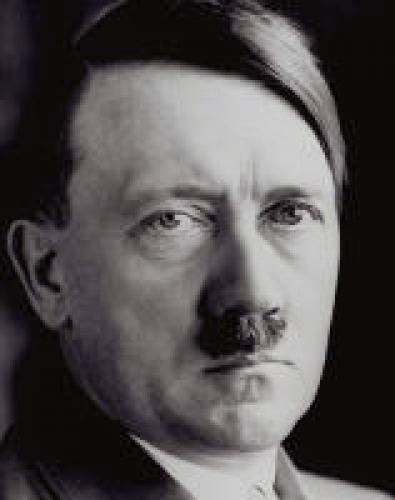
The most notorious environmentalists in history were the German Nazis. Hitler loved nature and despised non-German humanity. Hitler was both a strict vegetarian and animal lover. Hitler and his Nazis maintained their commitment to racial purity as an ecological ideal that justified the war. The mixture of anti-humanist and natural purity dogmas also provided a rationale and incentive for the Third Reich's most heinous crimes.
Hitler sought to decrease the population of the Earth and considered Jewish people as weeds to be eradicated. Ecological themes played a vital role in German fascism and the natural order dogma left no room for compromise. Nazi ecological beliefs were absolute and turned environmentalism into a religion with blond-haired, blue-eyed German men as its gods. Hitler, as Mother Nature's god of war, sought to purify the Earth according to his own view of sustainable development.
Adolf Hitler published his environmental and race views in a chapter entitled Nation and Race in Mein Kampf: "No more than Nature desires the mating of weaker with stronger individuals, even less does she desire the blending of a higher with a lower race, since, if she did, her whole work of higher breeding, over perhaps hundreds of thousands of years, might be ruined with one blow."
Source: http://healing-magic.blogspot.com
Agassou - The guardian of traditions and parental disciplines. Agau - Loa of the Winds
Agwe (Ogg-way): spirit of the sea
Aida Wedo: rainbow spirit Ayida-Weddo - Loa of fertility, rainbows and snakes. Wife of Dambala Ayezan - (Aizan, Ayizan) This is the Legba's wife. She protects the markets, public places, doors, and barriers, and has a deep knowledge of the intricacies of the spirit world. When feeding her and/or her husband, a black or white goat or russet colored ox is offered up. Her favorite tree is the palm tree. Ayida: The female counterpart of Dambalah. She is the mother Goddess. She is represented by the rainbow. Azacca (Zaka) - The loa of agriculture.Bade - Loa of the WindsBaka: an evil spirit who takes the form of an animal Baron Samedi: guardian of the grave. Loa of the DeadBosou Koblamin - A violent petro loa of Strength and Protection Brise: He is a loa of the hills. Brise is thought to take on the form of an owl. Speckled hens are slaughtered in his honor.Congo Savanne: A violent and cannabalistic petro loa. Dambala (Da, Damballah-wedo): serpent spirit, Damballah is the eldest God and chief of the LoasErinle: spirit of the forests Ezili (or Erzulie): female spirit of loveGhede - He is the most benevolent of the Loa of the Dead, powerful in healing. He is a protector of children as well as being a great jester. He is the loa of death and resurrection.Gran Boa - He is the protector of wildlife. He is the loa that must be called upon before one is ordained into the voudou priesthood. Grande Brigitte - the female Guardian of Graves. Her sacred trees are the elm and the weeping willowHeviosso: Thunder GodKalfu - A Petro Loa of the "crossroads," the Gate between the Worlds. Kalfu controls the evil forces of the spirit world. Krabinay: Krabinay loa are petro loa. Possessions induced by them are so violent that spectators are advised to keep their distance.
Legba (Papa Le Bas) - the Lwa of doorways and crossroads. The messenger of the god
Linglessu: One of the loa free masons.
Linto: The child spirit Loco: (Loko) The spirit of vegetation and guardian of sanctuaries. Loco is also a messenger loa and communication loa.
Marassa - The divine twins. The Marassa are a separate class of being that is quite apart from the loa. They are said to be the first children of God.
Marinette-Bwa-Chech: (Marinette of the dry arms) - The principal female Loa of the Petro rite, sometimes said to be the wife of Ti-Jean Petro. Considered to be very evil.
Mawu Lisa: spirit of creation Obatala: He is a sky loa. He is responsible for childbirth as well as for birth defects.Ogou Balanjo: spirit of healing Ogun (or Ogu Bodagris): He started out as the God of Blacksmithing but in time he transformed into the Spirit of War. His favorite tree is the mango tree. Osun: spirit of healing streams
Sango (or Shango): spirit of stormsSimbi: (Simba, Simbe, Simbi Andezo) He is the guardian Loa of the fountains and marshes.He is the Petro Loa of the coast.
Siren and Whale: These two loa are marine divinities, so closely linked that they are always worshipped together.
Sobo (Sobo Kessou): Loa of strength and reknown warrior spirit.
Sogbo - Loa of Lightning and protector of Flags.
Ti-Jean-Petro: This is a black magic or "petro" loa that is depicted as a dwarf with one foot.
Yemanja: female spirit of waters
Zaka (or Oko): spirit of agriculture
Note:This listing is by no means complete. Rather it is intended to give you a general view of the Vodoun pantheon
Tags: lifnim mishurat hadin balder than rune fehu rune ritual daily horoscope from astrology online original horoscope pronouncing the divine name real girls real ladies real life
From Christianity Today-
You're more likely to see a beard in the pulpit today than at any time since the 1800s. But beards-especially among clergy-were once serious, symbolic matters. They separated East from West during the Great Schism, priests from laity during the Middle Ages, and Protestants from Catholics during the Reformation. Some church leaders required them; others banned them. To medieval theologians, they represented both holiness and sin. But historian Giles Constable says that rules on beards sound more forceful than they really were. Clergy (especially powerful ones) were likely to follow fashion in their day, too.
c. 195
Clement of Alexandria calls the beard "the mark of a man" and says "it is therefore unholy to desecrate the symbol of manhood." Many other church fathers made similar remarks about beardly manliness. But most early church clergy were either beardless or had a closely trimmed beard.
361
Roman Emperor Julian sports a beard to show his break with the shaven Christian emperors before him, and to mark his connection to pagan Roman religion.
c. 411
Euthymius says only men with a beard can enter his Judean Desert monastery, not boys "with female faces."
More here-
Tags: in the salem witch trials of 1692 beliefs of world religion enneagram type seven in love mideast israel atlas development embryo fetus human human photographic prenatal handmade clay blue pentagram
A terrific post from Father Longenecker today that I want to share (Hat tip: New Advent):
It takes other forms as well. There is a tendency amongst some Catholics to turn their religion into an intellectual quest for 'true orthodoxy' or 'solid theology' or 'a message that is relevant for people today.' Others turn it into a search for 'a spirituality that really suits them'. I heard another priest going on the other day about "modern man's search for meaning and how each person must search the depth of their heart to find their heart's true desire and then at that point they will have the Christ encounter." Whaat? Sound like Jean Paul Sartre meets Dorothy Gale from Kansas.
I'm exaggerating, but you get my point.
What I'm realizing more and more is how very far the twenty first century church is from the simple preaching of the gospel and the core of the Catholic faith. What we don't hear is the old time religion. What has gone right over our heads is how influenced we are by modernism and the thought of Rudolph Bultmann who insisted that Christianity was old fashioned and needed to be 'de-mythologized'. He said modern man couldn't deal with the old, out dated cosmology of heaven and hell and sin and repentance and all that stuff. [...]
The gospel message is simple: You don't have to turn it into a quest for the perfect liturgy or a campaign for justice or peace or the creation of the perfect self help group. You don't have to turn it into an intellectual or existential quest to discover your true self or the source of your heart's desire.
You are unhappy and searching for something because you are imperfect. You have fallen short of the glory of God. This condition is called sin. You are a sinner. You are selfish, ego centric, lustful, unforgiving, angry, manipulative, self seeking and proud. You love pleasure rather than God and you will believe any lie as long as it allows you to continue in your sin. If you continue in this condition you will end up becoming more and more unhappy and eventually you will be separated from God, light, love, goodness, truth and beauty forever because that is what you chose.
The New Testament, and the message of the church down the ages is straightforward: "Repent and believe the gospel and be baptized". In other words, "Admit you are a sinner, turn to God for forgiveness. Accept the strange, but compelling truth that Christ died on the cross to forgive your sins. Receive his gift of new life with an open heart with nothing held back. Change your ways. Begin to live the Catholic faith in simplicity and honesty. Empowered by God's grace, live in the church, learn to pray, live with the sacraments, love others. This is the way you follow Christ."
Do, do go and read the whole thing.
Father Longenecker isn't saying that liturgy doesn't matter, or that orthodoxy doesn't matter, or that we can blithely disregard Church teachings so long as we embrace the simple message of the Gospel. Not at all. What he is saying, it seems to me, is that too often we get caught up in these other matters to the extent of not merely missing the simple message of the Gospel, but of making the unfortunate and devastating mistake of thinking that our pursuit of orthodoxy or liturgical correctness or, to be fair, of heterodoxy and liturgical permissiveness is somehow a fair substitution for trying to live our lives according to the message of the Gospel.
In other words, if we get caught up too much in, say, liturgical battles, to the point where we enter every Mass wearing our "Liturgy Police" hats and our best Roman scowls as we prepare to take extensive mental notes to add to our growing letter to the Papal Nuncio as to what everyone from Father to the smallest server is doing wrong today on the one hand, or wearing our Sunday shorts and tie-dye and our best icy smiles as we prepare to pounce on the least hint of Latin or reverence or formality with our special passive-aggressive vestibule chat after Mass on the other, the chances are good that we have lost sight of the simple message of the Gospel, which is that the person who is the polar opposite of ourselves in these liturgical battles might actually be closer to God by virtue of a humble habit of frequent Confession, a devotion to prayer, and an active life of service to the poor than we ourselves are.
And if we get too caught up in thinking that our specific way of living out our vocation (e.g. stay-at-home-mom! plus Catholic schooling! plus homeschooling! plus daily family prayers! plus godly blogging for the heathen! etc.) is the One Truly Right Way of Righteous Rightness, we might forget that the family whose public-schooled kids behave like little angels at Mass on Sunday could conceivably be doing a better job of loving their neighbor and their enemy and everybody else than we are-and that we should seriously not take it for granted based merely on externals that we're doing all that great of a job in the first place.
And if we decide that our particular family's economic status is the perfect one for Christians, with just enough money for all those important things that families ought to provide for their members with a decent amount left over for truly important charities, we might risk sneering at those people who have to do more for more family members with much less than we ourselves think of as "civilized" on the one hand, or snub everybody who has the money to buy more than necessities on the other as being too rich to be worth saving.
And if we spend all of our time fretting about the way other Christians dress, or the four-letter words other Christians use, or the bad movies or The whole of the Law amounts to two things, Jesus told us: you shall love the Lord your God with all your heart, and all your soul, and all your mind, and all your strength; you shall love your neighbor as yourself. The more we try to follow those two commands, the more we will find that humble, loving, honest spirit that is the best thing about Christianity as it can be lived in the world. And if we want to follow these commands, we have to take up our own cross, and follow Him.
Tags: christian fellowship mission statement the names of greek gods and goddesses ancient greek gods and goddesses list abbat of samhain moral outrage manning publications co. author erich von daniken
Still others had trial of mockings and scourgings, yes, and of chains and imprisonment. They were stoned, they were sawn in two, were tempted, were slain with the sword. They wandered about in sheepskins and goatskins, being destitute, afflicted, tormented. (Hebrews 11:36-37)
Very often, when people are trusting in the Lord to work by His grace, they anticipate many delightful workings of God (such as we have seen in the testimonies of Hebrews 11). These saints "subdued kingdoms, worked righteousness, obtained promises, stopped the mouths of lions, quenched the violence of fire, escaped the edge of the sword, out of weakness were made strong, became valiant in battle, turned to flight the armies of the aliens" (Hebrews 11:33-34). Yet, others experienced what might be called "unusual" consequences of accessing grace through faith.
They had to trust in the Lord when the aforementioned blessings did not occur. They had to trust God to sustain them in and through great difficulties of life.
Some had to endure by faith "trial of mockings and scourgings, yes, and of chains and imprisonment." Jeremiah exemplifies these. "O LORD...I am in derision daily; everyone mocks me...Therefore the princes were angry with Jeremiah, and they struck him and put him in prison" (Jeremiah 20:7; 37:15).
Some "were stoned." Zechariah was killed in this fashion when he gave warnings from the Lord. "So they conspired against him, and...stoned him with stones" (2 Chronicles 24:21). Some "were sawn in two." Tradition tells us that Isaiah died in this vicious manner. Some "were tempted." In the midst of their sufferings, they were further pained by enticements to ungodly responses. Job endured this through bad counsel from his own wife.
"Do you still hold to your integrity? Curse God and die!" (Job 2:9). Some "were slain with the sword." King Saul ordered godly priests to be executed this way, because they were loyal to David: " '...kill the priests!' So Doeg the Edomite...killed on that day eighty-five men..." (1 Samuel 22:18). Others "wandered about in sheepskins and goatskins, being destitute, afflicted, tormented." By faith, these saints had to endure homelessness, poverty, distress, and harassment.
These servants of the Lord (who are all examples of living by faith!) are a reminder to us that our trials, sufferings, and anguishing impossibilities do not necessarily mean we are failing to trust God. These challenges often mean that we are being given an opportunity to humbly, dependently, draw upon the grace of God in ways that we need to experience or others need to observe.
In service: Brother D.Eskine
Tags: norse magic freya godde reformed theology is flawed my 84th birthday celebrati viking attacks nocturnal witchcraft by konstantino list of celtic gods
Amber Dorrian, Wisdom Quarterly response to Figleafforum.com
Bodhisattva under a redwood tree, Sequoia Nat'l Park, CA (AllegoryImaging/Flickr.com)
"Lust" (kama- or raga-chanda, sensual-craving) is a strong desire to possess something. (Desire can seem neutral, but in Buddhism it is translating terms with a negative aspect since there are certainly "good" desires like the will and zeal to realize the liberating truth).
Christians and Muslims have a similar word in is covet. Christians learn that lust and covetousness are "sins" often without considering how or why. What about admiration, the wish to understand, the desire to find harmony? Love, compassion, altruism, and impartiality all express a desire but with a free and happy heart: It does not possess the object of our admiration.
Of course, it is impossible to "possess" things. But what is possible are the harmful mental actions of grasping and clinging, obsession and attachment. The heart is unable to let go. It binds itself. It does not have the object of its craving, yet it does have all the worries and costs of possession.
In a conventional sense, a person may be described as being possessed by objects one clings to. But who - other than the Five Aggregates - is clinging? Ultimately, "we" cling to the "factors of clinging." Those factors are called the Five Aggregates. But ultimate truth eludes us.
The title of this article may seem absurd; the story behind the article is even stranger. Our nude Christian friends at Fig Leaf Forum first asked the question in a theistic context. It was like an episode of the Daily Show's "This Week in God." It's beautiful the way things are explicable even with different assumptions about this world.
Do beautiful objects in our perceptual field - like trees, sunsets, newly nubile gals/guys/ponies - come about as acts of heavenly Creation or evolve along Evolutionary lines? There's truth in both views, except the polarities won't budge a whit. They thereby turn a blind eye to what is real and what is not. Taking sides is easy, reconciling why the sides exist is less easy but more beneficial. "It's a trap!" we can Admiral Ackbar and Cherry say. Both views are a trap.
No peace is coming between camps, just a few conversions, mostly of sciencey types turning churchy. The truth stands apart, and there would be much more peace if we could see what is right about each pole rather than dismissing one side as kooks and lauding ourselves as the great non-kooks. It's kooky. Keep your view, but keep all eyes open and investigating. Any bias, even a well intended one, causes us to look for confirmation not information. It's our confirmation seeking tendency.
If a particularly stunning tree or model or mountain or magazine cover comes into view, there is great pleasure in taking it in and enjoying its proportions, symmetry, interactive bits, and pleasing fullness (abstract concepts explaining why something strikes us as beautiful that, for less abstract thinkers might just be termed, oh who knows, "God's" handiwork).
Musicians appreciate well performed works and composing skills, jewelers are impressed by well set gems, nature buffs love natural (fractal, Fibonacci, golden mean) beauty. And the wise derive joy from truth, however counterintuitive the Truth may be.
As human beings we find other human beings most beautiful of all - attractive, creative, evolved, faithful, or intelligent, it hardly matters.
When the mind/heart first hits upon the idea of possessing, we're in line for disappointment and dissatisfaction (dukkha). What if we could be mindful instead, mindfulness being fully aware without thinking, judging, evaluating, planning, or measuring. "It is what it is," people foolishly say, but there's great wisdom in this foolishness. Of course, it itself doesn't say anything, yet something is being said.
Bare awareness means not becoming attached or enmeshed but just seeing, just knowing, just accepting, just allowing. It's very peaceful. It allows the right brain (our silent co-consciousness) to have a say. Of course, it won't speak, but it will communicate with feelings and a bodily sense we react to. ("We" being the left brain thinking portion that thinks, judges, and tries to possess). "Let it be, let it be," the Beatle said.
Will lust help or harm? We can have all that is, but we can possess none of it. What will we choose to try to do?
To carry this analogy further, beauty appears in all sorts of ways. Beauty is not to blame when lust arises. It's not even the reason for admiration. If it were, how would Buddhas, bodhisattvas, and arhats ever be freed from lust (craving, thirst, bondage, disappointment)?
Objects there, responses here. The world is the world; the heart/mind looking out on it can choose to notice this about it or that (the beautiful or the disappointment inherent in it), and then choose to either attempt to possess it or not.
Buddhism is very pleasing because it syncs up with psychology. And we modern Americans love all things psychology. It's no coincidence so many psychologists, therapists, neuroscientists, and the like are Buddhists. The Buddha focused on our internal experience of the external world far more than he spent talking about physics. As interesting and elegant as physics is, it can hardly hold an atomic candle to cognition, perception, emotion, motivation...
The Buddha gave physics its due ("form" means materiality, fine and gross, basic and derivative, four interdependent qualities or characteristics of material bodies). But he elaborated on our experience of the physical by giving psychology the lions share: sensations, perceptions, volitions, and consciousness are what beings cling to and what they can be freed from clinging to.
That freedom comes with enlightenment, is brought on by enlightenment, so much so that many well intentioned teachers and even monastics think nirvana and bodhi are synonyms. But bodhi is enlightenment, insight, awakening, whereas nirvana is complete freedom, peace, the end of suffering.
Oh to be free! Sex is sex. But clinging, attachment, obsession, possession, being consumed instead of consuming, that's just sad. Naturally, in the Sense Sphere (kama-loka) we like sense objects. That's normal. Is it normal to imagine we can "possess" or "keep" or "own" the composed and decaying object of person, be it tree or person, wealth or self?
All are falling away every moment. And in the meantime, we miss what is available - enlightenment and freedom.
We can't live without trees. Maybe some people can. But we can't. The trees, the trees, rooted in earth, reaching for the sky. Casting shade, dropping figs (and fig leaves), holding my back while I meditate. What meditation? I'm mindful. There is no straining in my striving. I'm just watching. Eventually I'm seeing things as they truly are. Ahhh. No words for it. The right brain knows. It's the left brain that conceives and tries to capture just the right wording.
But completely "detached from sensual objects, O meditators, detached from unwholesome states of mind/heart, a meditator enters into the first absorption, which is accompanied by applied attention and sustained attention, is born of detachment [withdrawal of the senses, samadhi, intensified-concentration opposing workaday dissolute-distraction] and filled with rapture and happiness" [the Buddha defining the first "absorption" or in Pali jhana, Sanskrit dhyana, Japanese zen, Chinese ch'an, Tibetan samten].
Turning this mind to objects of insight - vipassana practices - is suddenly fruitful. Loving-kindness! The breath having become a nimitta takes me to equanimity. The factors-of-absorption (jhana-anga) become my best friends. As such where have "my"
* sensual desire (lust)
* ill will
* sleepiness and laziness
* restlessness and worries
* doubts
gone? Hindrances fall and opposing states come in peace:
* applied attention (on my object of meditation)
* sustained attention
* rapture
* happiness
* concentration.
Turning the wheel (cycle) of "Dependent Origination" in mind, it becomes clear that this is the way to enlightenment. One persisting in this practice, strengthening absorption then applying that laser focus to insight practices, can see freedom in the distance.
Going, going, going beyond, going altogether beyond, O what an awakening, so it is!
It's a nice mantra not learned rote and repeated with bell and drum but uttered spontaneously - as words fail and contentment overtakes me.
* Thanks to the editors at Wisdom Quarterly for helping me putting into words.
Lust is discussed in Fig Leaf Forum revisited by Mark Roberts in a debate published in Issue 55/56 of their newsletter. This article is responding to Issue 59.
Fig Leaf Forum realizes that "Lust is a problem of the heart, not of the mind." But in Buddhism heart is mind (citta). Lust is a problem of both. If we were speaking the same technical English, we would agree. Lust does not help perception; it twists (kinks, perverts, distorts) it. "Love others as ourselves," yes! Love everyone! Choose lust at your peril. For what is possible here and what impossible is often found out too late. What is possible? Freedom from the bonds of craving.What is impossible? Actually possessing and controlling what we crave.
Tags: magic spells of love the secret mysteries of america's beginning voodoo friends sad boy finish strong aint herman of alaska monastery witch hunts of early modern europe
EMAIL FROM ALMANIAC VERA L: ONCE IN A WHILE SOMEONE DOES A NICE JOB OF DESCRIBING A CANADIAN, THIS TIME IT WAS AN AUSTRALIAN DENTIST.
An Australian definition of a Canadian In case anyone asks you who a Canadian is...
You probably missed it in the local news, but there was a report that someone in Pakistan had advertised in a newspaper an offer of a reward to anyone who killed a Canadian - any Canadian.
An Australian dentist wrote the following editorial to help define what a Canadian is, so they would know one when they found one.
A Canadian can be English, Scottish or French, or Italian, Irish, German, Spanish, Polish, Russian or Greek. A Canadian can be Mexican, African, Indian, Chinese, Japanese, Korean, Australian, Iranian, Asian, Arab, Pakistani or Afghan. A Canadian may also be a Cree, M'etis, Mohawk, Blackfoot, Sioux, or one of the many other tribes known as native Canadians. A Canadian's religious beliefs range from Christian, Jewish, Buddhist, Muslim, Hindu or none. In fact, there are more Muslims in Canada than in Afghanistan. The key difference is that in Canada they are free to worship as each of them chooses. Whether they have a religion or no religion, each Canadian ultimately answers only to God, not to the government, or to armed thugs claiming to speak for the government and for God.
A Canadian lives in one of the most prosperous lands in the history of the world. The root of that prosperity can be found in the Charter of Rights and Freedoms which recognize the right of each person to the pursuit of happiness.
A Canadian is generous and Canadians have helped out just about every other nation in the world in their time of need, never asking a thing in return. Canadians welcome the best of everything, the best products, the best Please keep this going! Pass this around the World. Then pass it around again. It says it all, for all of us.
'Keep your stick on the ice'
This email was cleaned by emailStripper, available for free from
Tags: have poised 3 word wednesday wise serpent crispin crispian shall ne sunday martyr moment luke trong gas smell in car