skip to main |
skip to sidebar
This is a response to what was called a debate on the question "Is There an Afterlife?" Here's the blurb from the website
In this recent Whizin Center for Continuine Education program, leading advocates for atheism, Christopher Hitchens and Sam Harris square off against Newsweek top rabbis, David Wolpe and Bradley Artson Shavit to determine what may or may not happen in the hereafter.
The possibility of an afterlife has challenged believers and atheists alike for centuries. Because its very nature defies conclusive definitions or proof, it remains a heated topic for debate and exploration. This debate is moderated by the Editor-in-Chief of the Jewish Journal, Rob Eshman.
There is a bit of false advertising in the claim that this is a "debate" about the afterlife. It's not. It's a beating around the bush with all four speakers dodging the main question.
As a Buddhist I would say that none of the four speak of the afterlife in the terms that are relevant to me. They don't seem to be speaking from experience, and instead all four are speaking about what they "trust" to be true by their intellectual speculation and dualistic modes of thinking.
In this debate, either the Rabbis didn't do their homework or they decided to stay on the defensive, as neither Rabbi directly challenges the bloodlust for the American Empire espoused by Hitchens and Harris in their written works. My guess is that there was some kind of pre-debate agreement that the Rabbis would not attack Hitchens and Harris directly and in exchange no one would mention how Israel is oppressing and killing people in the name of religion.
The dilemma of dealing with Hitchens and Harris is that they have their soft targets which they attack successfully and then they dodge away from the real issues and hard problems.
Hitchens rightly challenges the immature anthropomorphism and personification of a literal fantasy of God as a person with arms and legs and a long bearded "father" figure. That childish fantasy can be punctured but it doesn't amount to anything.
Hitchens approaches intellectual honesty when he says, "Survival of consciousness independent of the brain is different from religious belief in a mandated path you can either follow or not follow for reward or punishment." But if that is so, then he is acknowledging that he is avoiding the real subject of the former when he is attacking the misunderstandings of the latter.
Hitchens and Harris are essentially making a straw man argument by attacking institutional religion as if the religious aspiration in people is responsible for the conduct of the devils running the institution. If so, then that is also a great argument for abolishing democracy because of the devils running the USA today. The two rabbis David Wolpe and Bradley Artson Shavit apparently are not in a position to talk about the abuses, torture, and holocaust committed by our government in the name of democracy, since, as stated above, it might also lead to a discussion of the abuses committed by Israel. The problem of bastards and bullies running the government is a human problem that has nothing to do with whether the institution that controls the government is called democracy, communism, or the church.
Rabbi Shavit is right to point out the "worst compared to best" style of argument used by Hitchens is a rhetorical trick. With the comment that people "hold on to hopes that orient us" the conversation could have turned to the real question of how the symbol-systems, whether religious or not, orient people in a manner that gives them mutual identity and the ability to band together and become a society. The fact that there is an anthropomorphic patriarchal symbol of "God" or "His Majesty the King" or "Uncle Sam" or "Marx" at the center of the symbol-system is more determinative of it becoming and exploitive power hungry government than any religious sentiment. There is no qualitative moral difference in the basic sentiments of Moses, Jesus or Marx but each of their respective symbol-systems became controlled by people who couldn't care less about the moral sentiments of the men who inspired the symbol-system..
The problem for this program is that the question "Is there an afterlife?" is addressed from very different frames of reference. All four, in their own way, answer the question "We can't say if there is or not." Hitchins and Harris reframe the question as "Is the supernatural fantasy of God in Heaven believable?" Rabbis David Wolpe and Bradley Artson Shavit turn the question into "Is belief in an afterlife beneficial to some people and if so then it doesn't matter if it is true?" Both attempts to reframe the question are dodges.
Since Hitchens and Harris are really on a crusade against "religion," which they define as belief in a supernatural anthropomorphic God, they always turn the issue to the past misdeeds of totalitarian religions. In other words, Hitchens and Harris dodge the question of "Is there and afterlife" by saying "when religion is in control they are bad, so anything said by those religionists must be false."
Hitchens and Harris rest their position on the view that "religion is man made" and therefore it is false. I agree with them that piercing the self-delusional veil of those who believe their own religion comes from the "real God" while everyone else's religion is only "man made" is a worthwhile goal, but Hitchens and Harris themselves go about this crusade with as much intellectual dishonesty and self-delusion of their own. Chris Hedges has written about their hypocrisy in his article "The Dangerous Atheism of Christopher Hitchens and Sam Harris" with which I largely agree. (There are significant features of Hedges' article with which I disagree, but they are about his own pessimistic view of human nature, not his criticism of Hitchens and Harris.)
IS THERE AN AFTERLIFE?
If I had been on stage, I would have answered the question by saying plainly, "Yes. There is an afterlife and this is it."
At one point Harris nearly approached this issue when he spoke about sleep to point out that every night we fall asleep into the oblivion of consciousness. However, Harris failed to get to the logical observation that we don't go around fretting about "Is there an after-day?" Harris and the others missed this essential point.
We are certain of tomorrow because of our memories of yesterday. Yet we have no real certainty of tomorrow since anyone of us may not in fact live to see tomorrow if we die in our sleep, as any of us could were an airplane to fall from the sky. And though we have no absolute certainty of tomorrow, we have the certainty that today is the after-day of yesterday, and upon this certainty we rest our great confidence in the after-day of tomorrow.
Likewise, this life is the afterlife of the previous life, and our next life will be the after life of this life. The only difference between afterlives and after-days is our memory. We don't remember all of our yesterdays, but we remember enough of them so that we can put together a symbol-system for our expectation of the days to come. For anyone who has accessed the memory of a past life and discovered that this life is the afterlife of previous lives, the certainty of an afterlife after this life becomes as certain as tomorrow is to today.
Yes, the certainty is "man made" but so what? Every bit of human understanding, including science, is "man made" because we are humans who understand by making symbol systems. The question that Hitchens and Harris want to get to by the threshold admission of one's symbol system being "man made" is then to what degree does the symbol system comport with reality? And here's the rub. Hitchens and Harris are advocates and proselytizers for the symbol system of science and as such refuse to acknowledge how their "reality" is also "man made."
They believe that there is an objective "reality" that science is merely describing to the best of its current ability. They think that within this framework, they can hold up their scientific truths against the zany religious truths that have been promulgated and they win. However, as one of the Rabbis in the debate pointed out, there have been many zany propositions in the name of science and that doesn't make the scientific endeavor worthless.
The fundamental delusion upon which Hitchens and Harris operate their road show is their claim that there is only one reality, the one that they say there is. They do not acknowledge that the reality that religion is attempting to negotiate, describe, and understand is not the physical reality of matter but the psychic reality of what is variously called spirit, soul, mind, consciousness, etc. While I agree that there is only one reality, like the claim of only one God, that reality (and that God) appears very different to the different people who are taking different perspectives.
Our understanding of "matter" is constantly changing and so there is no one view of matter held by science any more than there is one view of God held by religion. The point that we should be able to agree on is that we should not demand that other people take our point of view. To the extent that Hitchens and Harris are asking people with firmly held points of view about their God to let others be, then they have a message I can agree with. But to the extent that Hitchens and Harris ridicule people's religion today because of the folly of the past, then they are committing the same sin they claim to oppose.
Underlying the quest for the answer to the question "Is there an afterlife?" is the angst caused by the very notion of time existing as past, present, and future. Any religion that wants to help people with this question of an afterlife must address the issue of time. When we look at time as past, present, and future we are taking ourselves out of time as if we exist in relation to time as a thing carried along the river of time. But in fact time is our very being. We are not external to time. We are the embodiment of time and time is another name for spirit, soul, God, consciousness, etc. We are no more outside of time than we are outside of God or mind. When we truly realize this there is a qualitative change in our sense of time and the generalized angst about the future is dissolved. At the same time, the issue of an afterlife is resolved by knowing that we are time itself and so we are the afterlife in this present moment.
Tags: the beginnings of ordo black magic spell casters wicca rituals astral20reflections20jul20162006 romney doesnt appear daily message march 7 all magic spells
CLICK (sgi-usa.org)
Some say Sokka Gakkai ("value creation") it is not "Buddhism." Some say it is a cult - a brain-washing (mind control through ritual mind-numbing chanting), family-rejecting, money-worshiping devotional movement that originated as a shortcut to buddhahood in Japan then became a very savvy organization with outreach. It might be.
It is also alleged to be the fastest growing form of Buddhism in America among Hispanics and African Americans and college students. That is reason enough to merit consideration. Buddhism is open to all, but not all national forms of Buddhism are as inviting as SGI.
[Chanting] The Secret of the Lotus Sutra
The Secret to Happiness
The secret is that there is no secret! Buddhism teaches that a universal Law (dharma) underlies everything in the universe. This is the very essence of life. One could also think of it as the fundamental rhythm of life and the universe. Nichiren [the Japanese founder of Nichiren Buddhism] identified this Law or essence as [the chant] Nam-myoho-renge-kyo. He taught that by correctly carrying out the practice of [this form of] Buddhism everyone is able to bring his/her individual life into harmony with the greater life of the universe. More
The infamous daimoku/Tina Turner chant
* Cult Awareness Network complaints about SGI
* RickRoss.com is an Internet archive of information about cults, destructive cults, controversial groups, and movements. The Rick A. Ross Institute of New Jersey (RI) is a nonprofit public resource.
* Need to be deprogrammed?
Tags: semana sant green iguana iguana iguana magic candle spells religion belief apb st oc preview episode 13 through our soles our free white magic spells
"Jewish halakhic decisions," says Rabbi Prof. Daniel Sperber, "tended throughout most of the generations to be user-friendly. There are impressive examples in halakhic history of the willingness of poskim (arbiters of Jewish law) to allow the taking of interest or to prevent the cancellation of debts in order to make economic life possible; to allow the sale of chametz on Pesach and a heter mechira (permission to sell land to a non-Jew) during the sabbatical year to prevent losses; even to impose severe sanctions on those who refused to grant a get (a religious divorce) or to release agunot (chained women, whose husbands cannot or will not grant them a divorce) under lenient conditions. Only in recent generations has pesika (issuing a halakhic ruling) become extreme and increasingly stringent."
This argument is not new, of course. For many years it was voiced by Conservative and Reform Jews, women's organizations and ordinary liberal religious Jews. The innovation lies in the speaker, his background and the knowledge that he brings to his argument. An Israel Prize laureate for his talmudic research, Sperber is president of the Institute of Advanced Torah Studies at Bar-Ilan University. A reknowned scholar of Jewish law and the Talmud, he also is the rabbi of a congregation the neighborhood where he lives in Jerusalem, the Jewish Quarter of the Old City.
In two
He traces the origin of the problem, as did many of his respected predecessors (chiefly historian Jacob Katz) to the extreme reaction of religious society in Europe to the phenomenon of Reform and the Haskala (Jewish Enlightenment movement). Since Reform Jews wanted to innovate, traditional Jews had to refrain from any innovation. This extreme position was reflected symbolically by the famous statement by the Hatam Sofer, the leader of the ultra-Orthodox community in Hungary in the 19th century, who declared that hadash (the new) is "forbidden by the Torah." (This was a paraphrase of a Jewish law in Temple times forbidding the eating of the new grain crop before the ceremony marking the Counting of the Omer). In short, any attempt at innovation regarding a specific custom was enough to invalidate it, even if there is no halakhic prohibition.
The Hatam Sofer influenced poskim and communities all over Europe, and the situation reached the absurd, according to Sperber: "Recently a book was published about the customs of the Mattersdorf community [in Hungary- Y.S.] in the mid-19th century. And it turns out that in this community the rabbis refused to allow a heater into the study hall and consequently it was so cold that most members of the community refrained from coming to the synagogue in the winter, and there's evidence that those who came had icicles running down from their beards, only because 'our forefathers did not have heaters.' In that same community they also avoided placing benches in the synagogue, and elderly people were forced to stand during the entire prayer service, for the same reason that 'Hadash is forbidden by the Torah.'"
Even major poskim, experts in the halakhic tradition, avoided innovation to the point of absurdity. Sperber tells of the testimony of the son of the Hafetz Haim (Rabbi Yisrael Hacohen of Radin, the main Ashkenazi posek of modern times) regarding his father, who refrained from introducing electricity into the synagogue, even on weekdays, because of the innovation it represented.
Ivory tower phenomenon
The second and more recent cause of extremism, says Sperber, is the central role that the large yeshivas and their heads began to assume in the Ashkenazi (European) halakhic world: "In the past it was common for the pesika to be issued in each community by the local rabbi. The rabbi was familiar with the nature of the community, its ability to observe various stringencies and the needs of the people, and therefore the decisions suited the community. The moment that the yeshiva heads became the main poskim the rulings became 'academic,' issued from an ivory tower, unconnected to the actual situation of the public, and in any case also tending to be stringent."
Incidentally, he points out, because the two phenomena - Reform Judaism and the large yeshivas - were not found in Sephardic Judaism (in southern Europe, North Africa and the Middle East), the phenomenon of halakhic extremism was avoided there.
In "Darka shel Halakha," Sperber deals particularly with what he considers a central example of "unfriendly" pesika: the subject of Torah reading by women. A priori, the Talmud determines that there is no problem with women being called up to the Torah, and only when it came to reading from the Torah "the Sages said that they shouldn't read because of the dignity of the public"; the most common interpretation of this explanation is that this could humiliate those men who didn't know how to read from the Torah.
For most of Jewish history the ruling did not even come up for discussion because the women didn't see themselves as candidates for reading from the Torah. But in recent decades feminism has also affected the desire of religious women to be full partners in religious life, including reading from the Torah. Sperber is convinced, and that is also what he rules, that they should be allowed to do so, adopting an approach of "friendly" pesika:
"First of all, today most religious men who come to the synagogue know how to read from the Torah, so, in any case, they should not be insulted by a woman reading. Second, just as there is concern for a public that is insulted when women read, another public can also "forgo its dignity' and decide that it is not insulted by this reading. And primarily - in contrast to the value of 'the dignity of the public' - preference should be given to the universal value of human dignity, because the moment women feel insulted by not being allowed to read, this insult is more important."
In the second book Sperber discusses another major problem that he sees as an obstacle to the poskim - the absence of sufficient scientific knowledge. He is referring mainly to their ignorance of the academic field of Jewish studies, which causes them to be unfamiliar with sources discovered in recent generations or differences of opinion between versions of various manuscripts, which could influence the pesika. As a basic example of that he mentions that Rabbi Yosef Caro, the compiler of the Shulkhan Arukh, which from the time it was written in the 16th century up to the present, has been considered the central book of halakha in the Jewish world, made his halakhic decisions by following the majority opinion in three previous books of halakha with which he was familiar: those of Maimonides, the Rif (Rabbi Yitzhak Alfasi) and the Rosh (Rabbi Asher ben Yehiel). "But in recent generations," says Sperber, "many halakhic sources that were totally unfamiliar to the author of the Shulkhan Arukh have been discovered, for example extensive halakhic literature from Provence. This literature could change the entire balance of majority and minority opinion in halakha, but the poskim will not allow any expression of that. The Hazon Ish [a central posek who lived in Israel in the 20th century -Y.S.] even said there is no need to take this literature into consideration, because apparently it was determined from above that this literature would not be discovered before the halakhic tradition was consolidated. Incidentally, Shas spiritual leader Rabbi Ovadia Yosef is actually willing to rely on the new literature, and in several places he rules contrary to the Shulkhan Arukh, in accordance with new sources that have been discovered."
Occasionally, it must be admitted, unfamiliarity with the various sources actually causes lenient halakhic rulings. For example, Sperber brings the famous case of the permission given by Rabbi Avraham Kook to sell the lands of the country during the sabbatical year. This permission was based, among other things, on previous poskim who ruled that there is no prohibition against selling land from Eretz Israel to goyim in our time, because the prohibition written in the Torah on this matter relates only to idol worshipers, and today's Arabs are not considered as such.
But manuscripts discovered in recent decades reveal that these quotes stemmed from censorship imposed by Christian rulers on the original pesika, which actually prohibited the sale of land from Eretz Israel to all the goyim, and not only to idol worshipers.
In the test of results, Sperber is not afraid of the practical significance of his discovery, "because there are enough other ways and reasons to allow the sale," but the basic principle is important.
By Yair Sheleg
Tags: free love magic spells psychic predicti emergency love spells how to find all 101 harvest sprites on harvest moon d friday follow magic spells and witchcraft psychic readers
Just got back from Spring Fling 2013 at my local occult shop. I love going there. I've been going since 1994. I'm going to have to take pictures and post them for my readers someday. Spring Fling is a sale where when you buy one item then you get the next item of equal or lesser price half off. They do these types of sales several times a year. I normally go for their Halloween sale and stock up on stuff. Let me tell you, the owner stayed up to 3:30am baking herbal cookies for customers. Man, where they good. I've never had herbal cookies before. I mean there were like lemon coriander, lavender cookies, cardamon, etc. I told her she needs to publish a cookbook with the recipes. There was also a masseuse, a crystal vendor selling some wonderful jewelry and stones, and there was supposed to be some one there for of entertainment but I guess they weren't there when I was there.
Interesting thing, the masseuse offered to give me a massage but I declined because I tend to pick up other people's conditions easily and especially when touched. But she seemed nice and I wished her well.
So I went knowing I was going to purchase a pendulum. If you ever shopped for a pendulum it can take a while because you got to find the right one for you. Well, I got down to two. One was a smoky quartz with a wolf pendant. The other was an amethyst with a triquetra. I immediate realized that the wolf one was male and the triquetra one was female. So I kept racking my brain trying to decide which one to buy when my little inner voice kicked in, "Get 'em both, dummy". LOL So I purchased both of them. My one with the wolf I'll use for my male clients and the triquetra one I'll use for my female clients. So when I bought them I was given all these extra goodies in the bag that jut made my day. I got a small baby-blue drawstring bag filled with semi-precious stone chips, two rose rocks (the official Oklahoma state rock), candy, a pen, incense sticks, and a 15% of card for my next visit. I was really impressed but then again I love this store.
I don't know if you remember me writing on this but a client gave me this HUGE box full of Wiccan stuff. I didn't know what to do with it. I mean, there's tons of statues, cauldrons, a Ellegua head, stone boxes, pentacles, and all kinds of other stuff. I thought about just selling them on my blog but realized it would be too much of a hassle with shipping. So I talked with one of the employees and so they are going to take them and will sell them on consignment. So I'm really happy about that. Saves me a lot of problems and hassles.
At one point I almost thought I was going to make a vaping convert. A former occult shop owner (her shop closed a few months back) was there giving readings and mentioned she had to take a smoke break. I brought up vaping and either she didn't hear me or willingly chose to ignore me but she walked right past me and out the door. Then one of the new employees I'm not familiar with came up to me and told me that they've been trying for a long time to get her to switch to vaping, as all of them had too. I was like, "Yeah, I love vaping and it's saved my life for sure.".
So I'm pooped out. Time for a nap.
Credit: http://magic-and-spells.blogspot.com
With a wonderful exhibition called Journey Through the Afterlife: Ancient Egyptian Book of the Dead just having begun at the British Museum, I thought I'd choose an image of Egypt for my Pagan Eye post this week.
Here is a picture of sunset over the Nile, which I took while I was on holiday in Egypt several years ago. The photo was taken from a boat on the Nile. I think the silhouetted buildings you can see on the river bank are in Cairo, but I might be misremembering. If you recognise the view, do
Tags: love spell telenovela learning to lucid dream isis paranormal christmas in the occupied holy land black magic spells uk high magic spells
I love VIKING SYMBOLS because they are filled with beautiful imagery and the powerful stories and mythology from the Norse culture. Here are some of my favourite Viking signs and symbols that have also been made into gorgeous PAGAN JEWELLERY.
JORGMUGAND AND THE SUNWHEEL
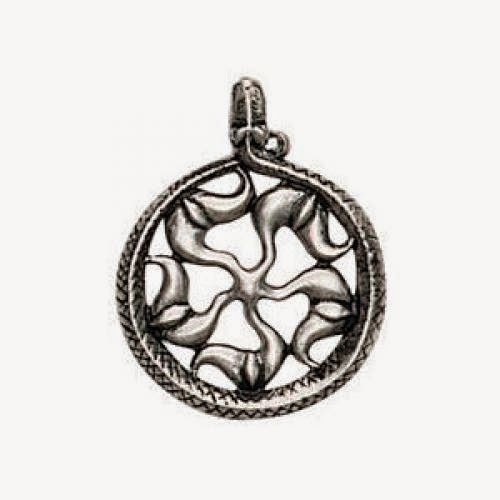
Jormugand is a sea serpent that was one of the three children of Loki and his wife the giant Angrboda. Jormugand was growing very quickly and this made the other gods nervous, so one day Odin decided to throw him into the sea.
Viking Symbol - Sunwheel and Jormugand
This didn't really do much as Jormugand grew bigger and bigger until he was able to surround the whole world and grasp his own tail, and because of that he earned the name Midgard Serpent or World Serpent.
Jormugand can be found deep in the ocean where he bites himself in the tail, and we are all caught in the coils of his tail. In many ways then, this Viking symbol stands for the concept of eternity, or perhaps the cyclical nature of life, on the other hand we are still left with a feeling of uncertainty (NO FLUFFY HAPPY ENDINGS IN VIKING MYTHOLOGY!) since the story goes that if he lets go of his tail we will all die, and when the universe ends, Jormugand and his arch enemy Thor will fight to the death.
However this symbol can be made less dark in the way it is shown in the pendant on the right - JORMUGAND CIRCLING THE SUNWHEEL.
The Sunwheel is a very sacred symbol which can be found on rock carvings and ancient jewellery from the Norse times. The sunwheel symbolises how important sun is to farming and agriculture, and so added to Jormugand really does represent the cyclical nature of life.
THOR'S HAMMER
Thors Hammer
THOR'S HAMMER, known as Mjollnir, is the hammer (SOMETIMES DEPICTED AS AN AXE OR CLUB) of the fearsome god Thor, and was a very popular pendant in ancient times, since many ancient hammer jewellery pieces have been found.
This mightily powerful weapon is even capable of leveling mountains and so becomes a wonderful way of symbolising strength, both inner and outer, and also precision, since using Mjollnir meant that Thor would never fail in his aim.
Other magickal qualities of the Hammer meant that Thor could throw it and always find it again, and also he could make it so small that he could hide it in his Tunic if he wanted to. Having a small pendant then, that you can display or hide under your clothes, seems very fitting!
Thor was a particularly popular god for medieval Scandinavians and many ancient pendants of his hammer have been found, and is now an important figure for many Pagans.
The Hammer of Thor was also worn by people as a way to outwardly display their Pagan faith and as to show their opposition to Christianization. Many people also practiced syncretic beliefs, meaning the combining of two or more religions, and moulds of a combined cross and hammer have been discovered. This can be seen in the WOLF'S CROSS which was a famous Icelandic pendant, worn by both Pagan Vikings and Christians.
EAGERSHELM
Eagershelm aka Aegishjalmur
Aka AEGISHJALMUR - aka "helm of awe'. This Viking symbol was used for protection, particularly in battle. It was originally a helmet won by Sigurd when he killed the dragon Fafner, but for the Viking people it was not actually used as a helmet, instead this symbol would be worn over the forehead, maybe scratched into the inside of the helmet, or even drawn on the head using blood or spit.
A warrior about to go into battle would press Aegishjalmur against his head (OR DRAW IT ON) and say '"I bear the Helm of Awe"', giving him power and strength in battle, both mentally and physically.
There are also other ways of using and conceptualising Eagershelm, for instance it can be used to put fear into the minds' of enemies or even to calm the fear in yourself.
Elhaz
Further magic can be found in the Aegishjalmur, in the way that runes are hidden inside the symbol, particularly the rune Elhaz which can be also be used for protection, and is thought to symbolise an elk's horns - a powerful symbol of self protection.
Elhaz keeps in good energies and helps to repel the bad, making it ideal for creating a sacred space or even pushing away negative energy and negative people. This rune can be found eight times over at the ends of spokes of this sign, but also eight times more within the spokes itself, making Aegishjalmur an incredibly powerful viking symbol.
I hope you enjoyed this article, feel free to share your favourite things from Norse symbolism. For more Viking Symbols and Pagan Jewellery, please visit my shop! Or read this article to find out how to magickally charge your jewellery.
Tags: all you need 2010 happy birthday happy birthday megaupload aleister crowley drawing crafting brilliant spirit essence internet church service sunday book of black magic spells
A light rain falls in these California redwoods. I am walking back to my nest, the VW camper van that is my home for the next week at Witchcamp where I have come to be with witches of all genders from all over the world. It is dark: no Moon is visible, though Her fullness above the clouds makes Her presence felt, tugging on every cell of my body's oceans. It is not a cold night, damp but surprisingly mild. There is a small footbridge crossing the shallow stream before I get to where I am parked. I am alone in the sweet darkness. Walking to the edge of camp after the opening ritual. I am still barefoot, shoes in hand, and, instead of taking the bridge, I wade into the creek. It flows around my ankles and halfway up my calves. It is also surprisingly warm and so I stop and turn off my flashlight and let my skin do what it does best: feel. There are no more shoes for me at Witchcamp, this is too powerful a place, too powerful an experience to miss anything through the soles of my soul.
The next day someone asks, "Don't those rocks at the stream's edge hurt to walk on?" I reply, "I go barefoot a lot. I have Hobbit feet." But the truth is that if I walked on those rocks the way I do in shoes, it would hurt. The faster pace and heavier trod would bruise me. Yet, because I am barefoot, I walk slower, lighter, with greater intention. And, because I am barefoot, I don't have to avoid the mud puddles in those first few days of camp before the sun finally dries out the ground mid-week. I can, with glee and full abandon, splash right in and feel the mud squish between my toes.
As the week progresses we dive into the myth of the Sumerian goddess Inanna. Together we descend into the underworld realm of her sister, the goddess Ereskigal. I walk Her descent barefoot. In the story, Ereskigal strips her sister of something at each of the seven gates to the underworld until Inanna finally arrives naked. As we wade deeply in the story, I too relive a time thirteen years ago when my life was stripped away. The memory is vivid as if it were seeping up from the forest floor through the cells of my soles.
In the myth, motive is unclear, but there is a breach in the sisters' relationship and Ereskigal casts upon Inanna the eye of death and hangs Her exposed and lifeless. I remember my own experience of leaving a very successful work position in 2000, thinking I was going to move into a PhD program, one that didn't materialize. Like Innana, my work, my identity, and my sense of carefully constructed ego, were stripped away. I had to finally face a pattern of depression and relationship choices that had been shadowing me since college. In the story, Inanna hangs there for three days. I hung in the depression long enough for my eyes to become accustomed to the dark - long enough to realize hanging in the dark can actually be a relief, a repose, a rest, and a place where nothing is required of us. I hung in the dark long enough to realize that the dark is no scarier than what's up there in the light.
In the myth, Inanna has allies and help, as did I. The god Enki sends flies to the underworld to empathize with Ereskigal who is in constant labor giving birth to the dead. Ereskigal, moved by their empathy, wants to gift them. They ask for Innana's corpse and reanimate Her with the water of life and the food of life. At the next evening's ritual, still barefoot, I remember, like Inanna, my own reanimation back to life and the sacred circles of folk who brought me aid, support, and tenderness.
The ascent was in some ways harder than the descent for both Inanna and myself. Slowly and painfully, I transitioned from one kind of life to another, one kind of way of being in the world into another, and re-emerged into the upper world of light, changed forever. Now, I love my current life, and found myself filled with love and thanksgiving to Ereskigal for the painful and cathartic process. Working this myth at camp, I re-emerge barefoot, with gratitude for the life flowing up through my soles into my soul.
My story is common. Most of us find resonance in these ancient archetypal myths because to walk the Earth is to love and struggle, to lose and find, and to discover our own true power often after being stripped of, or letting go of, something or someone. The pantheons of deities continue to infuse our very cells with the wisdom of these stories, spiral turn after spiral turn, as we walk barefoot through time.
I recently read a medical article about the health benefits of walking barefoot on the Earth. It turns out it can actually reduce the risk of heart disease, boost our immune system, and may help regulate both the endocrine and nervous systems. Each of us, and the Earth Herself, is a lovely collection of sacred cells, embodying the Feminine Divine. May the power and gifts of The Goddess fill our souls through our soles, and may we in turn give Her back our barefoot devotion.
For more about the health benefits of walking barefoot on The Earth go to:
Tags: mental illness repairing finding your passion true self spell men as provider protector problem solver large meatball filling facts about gods and goddesses